
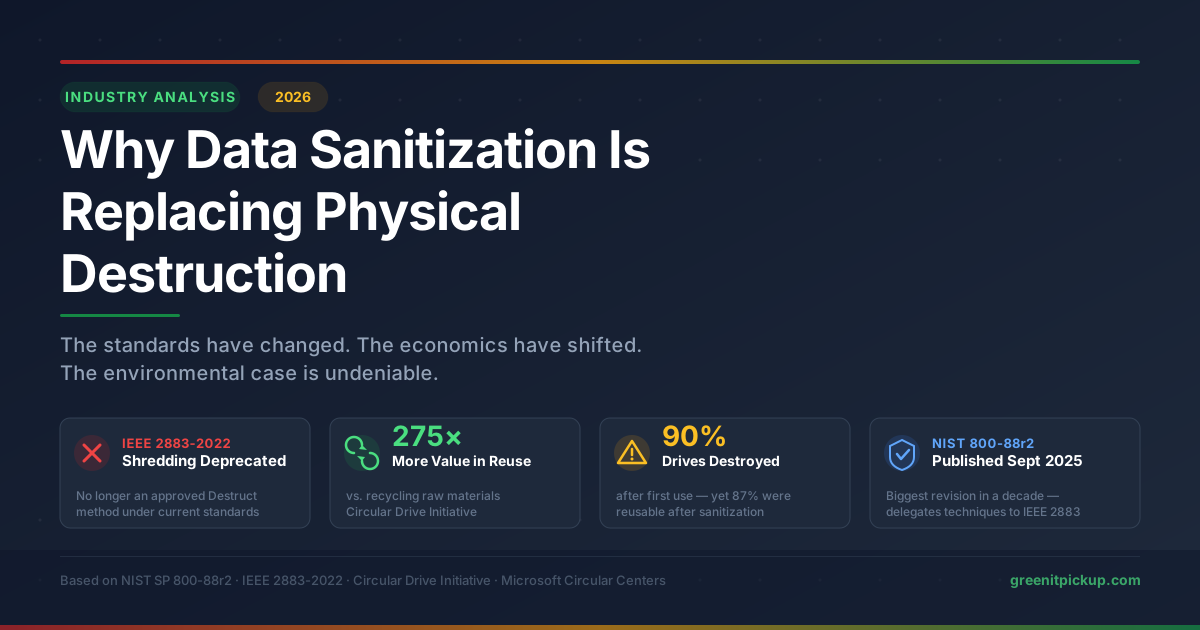
The End of “Just Shred Everything”
The most common method of physical data destruction in the ITAD industry — drive shredding — is no longer recognized as an acceptable sanitization method by the standards body that NIST now defers to. If that surprises you, this analysis is worth your time.
The IT industry is undergoing a fundamental shift in how it thinks about end-of-life data security. For decades, physical destruction — shredding, degaussing, incinerating — was the default approach to data-bearing media at end of life. It felt safe. Viscerally, undeniably safe. If you can hold a pile of metal fragments in your hand, you know the data is gone. That certainty made physical destruction the path of least resistance for IT directors, compliance officers, and C-suites alike.
But in 2026, the standards bodies, the hyperscalers, the ESG frameworks, and the economics are all converging on the same conclusion: physical destruction is overkill for the vast majority of enterprise use cases, and it comes with costs that most organizations haven’t fully accounted for. The updated NIST 800-88 Revision 2, published in September 2025, represents the most significant revision to federal media sanitization guidelines in over a decade. IEEE 2883-2022 — the technical standard NIST now defers to — has deprecated shredding and pulverizing entirely. Microsoft’s Circular Centers are recovering over 90% of server components for reuse. The Circular Drive Initiative estimates that reusing a drive delivers up to 275 times the environmental value of recycling its raw materials.
This is no longer a niche technical debate. It is a strategic decision with security, financial, environmental, and compliance implications that touch every organization retiring IT equipment. The question isn’t whether to take data security seriously — it’s whether your approach reflects the current evidence or a decade-old assumption. When should you sanitize? When should you destroy? And why does the distinction matter more now than ever?
What the Standards Actually Say: NIST 800-88r2 and IEEE 2883
Any serious discussion of data sanitization has to start with the standards, because the standards have changed more in the past two years than in the preceding decade.
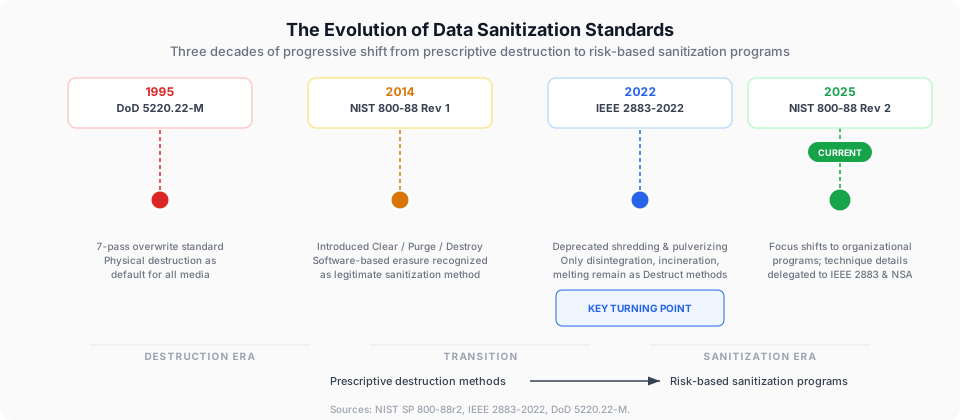
NIST Special Publication 800-88 Revision 2, published in September 2025, represents a philosophical shift in how the federal government thinks about media sanitization. Where Revision 1 (published in 2014) prescribed specific technical procedures — multi-pass overwrites, degaussing field strengths, and the like — Revision 2 moves upstream. It focuses on establishing organizational media sanitization programs: policies, risk assessments, documentation, verification, and accountability. The nuts-and-bolts technique specifications have been deliberately delegated to IEEE 2883 and NSA specifications, creating a cleaner separation between governance and implementation.
This delegation matters because IEEE 2883-2022 — the standard NIST now points to for technique-level guidance — contains a finding that has enormous implications for the ITAD industry.
IEEE 2883-2022 has deprecated shredding and pulverizing as acceptable Destruct methods.
IEEE 2883 defines three sanitization levels: Clear, Purge, and Destruct. Under the Destruct category, the only approved methods are now disintegration, incineration, and melting. Shredding and pulverizing — the two most widely used physical destruction techniques in the commercial ITAD sector — were removed. The reasoning is straightforward: modern storage density is so high that shredded fragments can still contain recoverable data. A technical analysis from Horizon Technology noted that the deprecation reflects advances in forensic recovery capabilities that have outpaced the granularity of most commercial shredders.
This is an enormous practical shift. The most common form of physical destruction in the IT asset disposition industry — the mobile shredding truck that arrives at your loading dock, feeds drives through an industrial shredder, and hands you a certificate — is no longer recognized as an acceptable sanitization method under the current IEEE standard.
Meanwhile, Purge-level sanitization — which is software-based — remains fully approved and endorsed. Approved Purge techniques include multi-pass overwriting, block erase, and cryptographic erase. For self-encrypting drives (SEDs), cryptographic erasure completes in milliseconds — faster than the time it takes to carry a drive to a shredder. Both NIST and ISO endorse cryptographic erasure as a Purge-level method that renders data forensically unrecoverable. The standards bodies have spoken: properly executed software-based sanitization provides equivalent security assurance to physical destruction, without the environmental and financial costs that destruction entails.
The SSD Problem: Why Physical Destruction Doesn’t Work Like You Think
There is a specific technical reality that most businesses — and, candidly, many ITAD providers — don’t fully appreciate. The physical destruction methods the industry relies on were designed for hard disk drives, and their effectiveness degrades significantly when applied to solid-state storage.
Hard disk drives store data on spinning magnetic platters. Degaussing disrupts the magnetic field; shredding tears the platters apart. For HDDs, these methods have a defensible technical basis, though even here, modern areal density means that shredder particle size matters enormously — a fragment that was too small to read in 2010 may contain thousands of recoverable sectors today.
Solid-state drives are a fundamentally different architecture. SSDs store data on NAND flash chips distributed across multiple packages on a printed circuit board. When you shred an SSD, you’re shredding a circuit board — but individual NAND flash packages can survive the process intact. Those surviving chips can be read using chip-off forensic techniques, a capability that Jetico’s technical analysis of erasure methods discusses in detail. The data isn’t gone just because the drive housing is destroyed.
Degaussing is even more problematic. There is no magnetic media on an SSD — degaussing has literally zero effect on flash storage. Yet organizations continue to pay for degaussing services without realizing that a growing percentage of their drive inventory is solid-state. Consider a scenario we encounter regularly: a mid-size company decommissions a rack of Dell PowerEdge R750xs servers, each populated with NVMe SSDs. They call a shredding vendor, pay $20 per drive, and receive a certificate of destruction. What they don’t realize is that NVMe drives on a PCB can leave intact NAND flash packages after shredding — and that the degaussing step included in their “comprehensive” destruction package did literally nothing to flash media. They paid a premium for a process that the standards bodies have flagged as inadequate for the exact technology sitting in their servers. In our DFW operations, we see this constantly — businesses paying for hard drive degaussing services without realizing that half their inventory is SSDs. They’re paying for a service that has zero effect on the drives that actually need it.
Cryptographic erasure and ATA Secure Erase are purpose-built for flash storage and are the methods recommended by both NIST and IEEE for SSD sanitization. As enterprise SSD and NVMe adoption accelerates — these technologies now dominate new server deployments — organizations still defaulting to physical destruction are increasingly using techniques that the standards bodies have identified as inadequate for the very media they’re attempting to destroy.
The Environmental Case: ESG, Circular Economy, and the True Cost of Shredding
The security argument for software-based sanitization is strong on its own terms. But the environmental dimension transforms this from a technical preference into a strategic imperative.
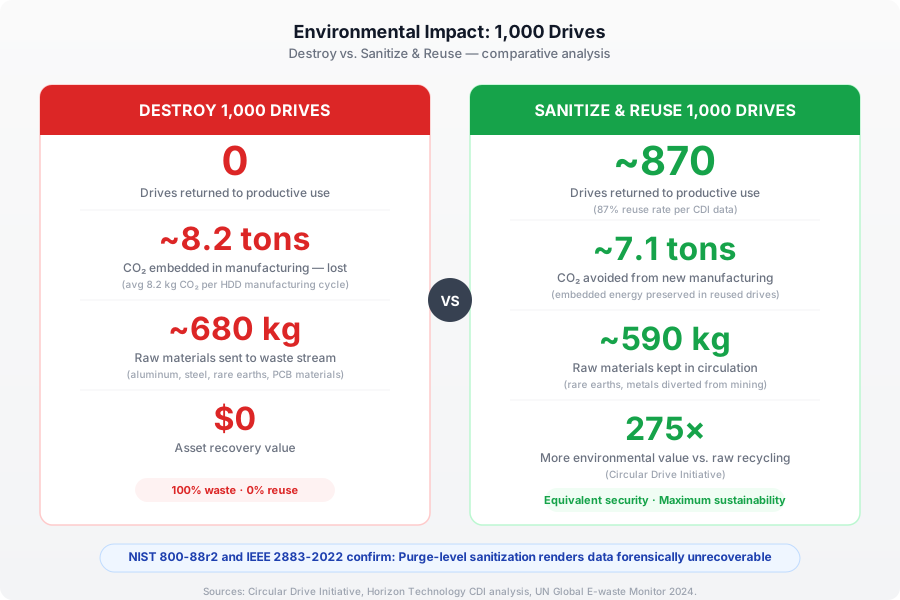
The scale of waste in the current model is staggering. According to the Circular Drive Initiative (CDI) — a consortium that includes Seagate and major data center operators, convened under circular economy pioneer William McDonough — data centers currently destroy up to 90% of storage devices after first use, primarily due to security concerns. Yet an estimated 87% of those drives are functionally reusable after proper sanitization. The CDI’s Data Sanitization Best Practices Guide, published in alignment with IEEE 2883, ISO 27040, and NIST 800-88, makes the case that the industry’s default to destruction is creating an environmental problem that doesn’t need to exist.
The numbers put this in perspective. Horizon Technology’s analysis of CDI data found that reusing a drive has up to 275 times more environmental value than recycling its raw materials alone. That ratio captures the embedded energy of manufacturing — the rare earth mining, the semiconductor fabrication, the precision assembly — that is irretrievably lost when a functional drive is shredded.
The hyperscalers have already internalized this math. Microsoft’s Circular Centers program — operating across seven global facilities with new capacity planned in San Antonio, TX — achieved a 90.9% server and component reuse and recycling rate in 2024, a year ahead of their 2025 target. For drives that genuinely cannot be reused, Microsoft developed an acid-free HDD dissolution process through their #NoShred initiative that recovers 90% of elemental and rare-earth materials with an estimated 95% reduction in emissions compared to traditional mining and processing. The signal from the largest technology companies in the world is unambiguous: destruction as a default policy is obsolete.
The broader e-waste context makes this urgency clear. The UN Global E-waste Monitor 2024 reported 62 million tonnes of e-waste generated globally in 2022, with only 22.3% properly collected and recycled. E-waste is growing five times faster than recycling capacity. The global e-waste market is valued at $62.96 billion in 2026, projected to reach $85.9 billion by 2030 at an 8.1% CAGR. Data storage and transmission alone contribute approximately 330 megatons of CO2 annually — roughly 2% of global emissions.
For organizations with ESG reporting obligations, this creates both risk and opportunity. ESG assets are projected to exceed $53 trillion globally, representing over one-third of total assets under management (Bloomberg Intelligence). The circular economy could reduce carbon emissions by 22% while generating $6.7 billion in annual material savings by 2030 (Ellen MacArthur Foundation). Metrics like devices reused, materials recovered, and CO2 avoided can appear directly in sustainability disclosures and annual reports. Every drive that gets shredded instead of sanitized and reused is a missed opportunity — for the environment, for the circular economy, and for the organization’s own sustainability metrics. When the standards confirm that sanitization is equally secure, destruction becomes an environmental choice, not a security one.
The Financial Case: Destruction Is the Most Expensive Option
The environmental argument resonates with sustainability teams. The financial argument resonates with everyone else.
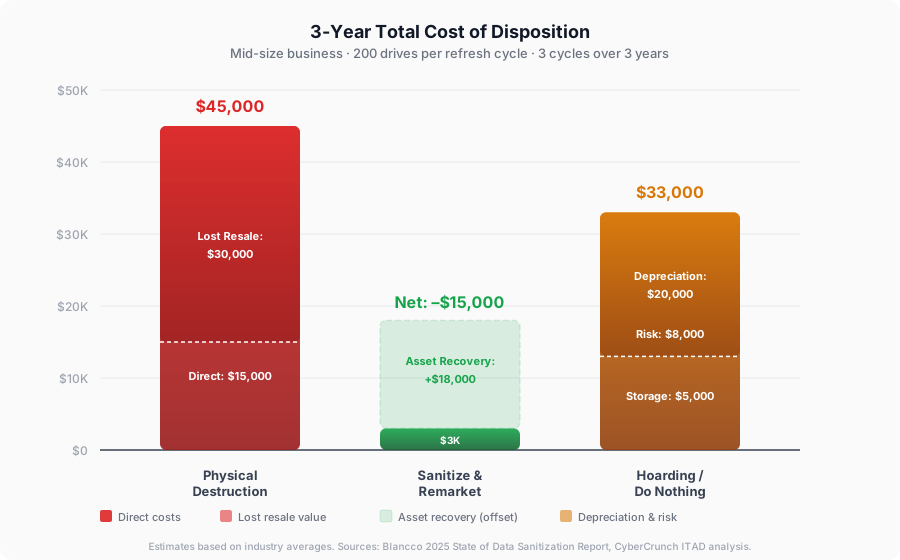
The economics of physical destruction are straightforward — and unfavorable. Certified shredding typically runs $10–25+ per drive, with additional per-device processing fees, transportation costs, and certificate-of-destruction documentation. For a mid-size enterprise retiring 200 drives per cycle, that’s $2,000–$5,000 in direct destruction costs alone, with zero asset recovery. Every destroyed drive represents not just the cost of destruction but the forfeiture of whatever resale value that equipment carried.
Software-based sanitization inverts this equation. Sanitization can be performed in-house or by a local ITAD operator at significantly lower cost — and in many cases, it’s included as part of free equipment pickup services for qualifying volumes. More importantly, sanitized drives remain functional and retain their market value. Organizations implementing data wiping programs commonly achieve asset recovery revenues covering 40–60% of total ITAD program costs. The Blancco 2025 State of Data Sanitization Report found that destroying functional devices costs large enterprises over $1 million every three years, with an additional $1.1 million in lost resale value — a combined impact exceeding $2 million per refresh cycle.
There is a third option that many organizations practice without acknowledging it: doing nothing. Drives sit in storage closets, accumulate in IT cages, and pile up in warehouses. The hidden costs of hoarding include storage space, ongoing security liability from unwiped drives, steady asset depreciation (a three-year-old drive is worth meaningfully more than a five-year-old drive), and cumulative compliance exposure from sensitive data that was never properly sanitized. Hoarding is not a strategy — it’s deferred risk.
When a DFW business hands us a rack of Dell PowerEdge servers that were running production workloads last month, those servers have real market value. We sanitize them following NIST 800-88 guidelines, provide a certificate of data sanitization, and put them back into productive use through our enterprise hardware division. If those same servers had been shredded, everyone loses — the business gets nothing, the buyer who needed affordable enterprise hardware gets nothing, and the materials go to waste.
When Physical Destruction IS the Right Call
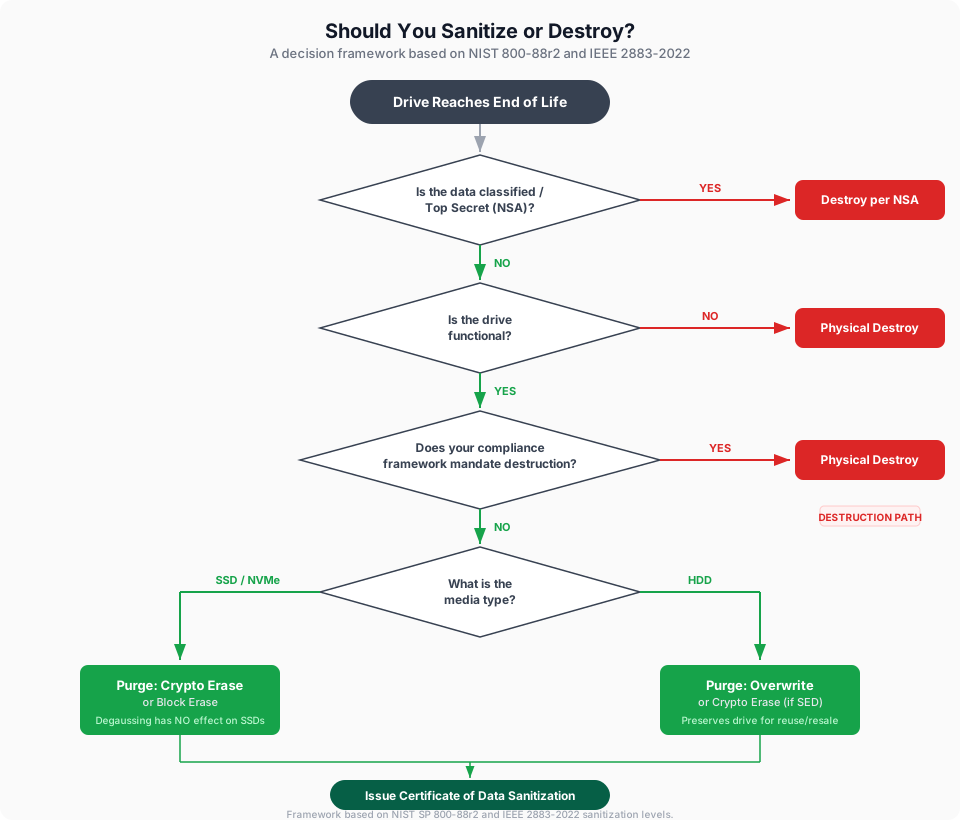
Intellectual honesty requires acknowledging that physical destruction is not obsolete — it’s narrower in application than most organizations assume. There are scenarios where destruction is not just appropriate but required, and any responsible analysis must delineate those boundaries clearly.
Classified and top-secret government data sits at the top of this list. NSA guidelines mandate physical destruction for certain classification levels, and that requirement is non-negotiable. No software-based method, regardless of its technical efficacy, satisfies the regulatory framework for these use cases. Organizations handling classified material should follow NSA specifications without exception.
Drives with hardware failures present a straightforward practical constraint. If a drive won’t power on, won’t be recognized by a host system, or can’t complete a sanitization routine, software methods simply cannot reach the data. Physical destruction is the only option for non-functional media, and responsible ITAD operators maintain destruction capabilities for exactly this reason.
Specific regulatory mandates in certain industries explicitly require physical destruction. When a compliance framework makes that requirement unambiguous — and some do — that requirement supersedes the general analysis above. The obligation is to understand what your specific framework actually requires, not to assume it requires destruction because that’s what the industry has always done.
Self-encrypting drives where encryption was never enabled represent an often-overlooked edge case. Cryptographic erasure works by destroying the encryption key, rendering the encrypted data unrecoverable. But if a self-encrypting drive was deployed without encryption ever being activated, there is no key to destroy. Overwrite or physical destruction becomes necessary.
Finally, there is the matter of organizational risk tolerance. Some organizations, regardless of what the standards say, maintain a zero-tolerance policy toward any residual risk from software-based methods. That is their prerogative, and it’s a defensible position when made deliberately. The point is not that destruction is wrong — it’s that destruction should be deployed based on a documented risk assessment, not as a blanket policy born from a decade-old assumption that shredding is the only “real” way to handle data.
The Decision Framework: A Practical Guide
The preceding analysis distills into a practical decision framework that any organization can apply to its end-of-life media. Six factors determine the appropriate sanitization method for a given device.
Factor 1: Data classification. What is the sensitivity level of the data on the drive? Public and internal data have different risk profiles than confidential, regulated, or classified information.
Factor 2: Media type. Is this an HDD, SSD, NVMe drive, tape, or optical media? The effective sanitization methods differ significantly by technology.
Factor 3: Drive functionality. Can the drive power on and complete a sanitization routine? Non-functional media cannot be software-sanitized.
Factor 4: Encryption status. Was encryption enabled on a self-encrypting drive? If so, cryptographic erasure is the fastest and most efficient Purge method available.
Factor 5: Compliance requirements. What does your specific regulatory framework require — HIPAA, PCI-DSS, SOX, CMMC, or others? Requirements vary, and assumptions are not substitutes for verification.
Factor 6: Residual value. Does the equipment have meaningful resale or reuse value? This factor doesn’t affect the security decision, but it affects the total cost of the disposition decision.
| Scenario | Recommended Method | Rationale |
|---|---|---|
| Standard business data on functional HDD | Purge (overwrite) | Forensically unrecoverable per NIST/IEEE; preserves drive for reuse |
| Standard business data on functional SSD | Purge (crypto erase or block erase) | Only effective method for flash storage; degaussing has no effect on SSDs |
| HIPAA/PCI-regulated data on functional drive | Purge with certificate of sanitization | Meets compliance requirements with documented chain of custody |
| Failed or non-functional drive | Physical destruction | Software cannot reach data if the drive won’t operate |
| Government classified data | Physical destruction per NSA specifications | Regulatory mandate — no discretion applies |
| Equipment with significant resale value | Sanitize and remarket | Financial and environmental upside with equivalent security assurance |
What This Means for DFW Businesses
Dallas-Fort Worth is not a passive observer of these industry shifts — it is at the epicenter. DFW is the second-largest data center market in North America, with 605+ megawatts of capacity under construction and inventory projected to more than double by the end of 2026. That expansion means an unprecedented volume of storage media rotating out of production environments and into the disposition pipeline.
Beyond the data center market, DFW has ranked as the number one metro in the nation for corporate headquarters relocations, attracting 100 new corporate headquarters between 2018 and 2024 — including major moves like KFC’s global headquarters to Plano and continued inbound momentum heading into 2026. Every one of those relocations generates an office (or campus) full of equipment that needs responsible disposition, both at the origin and the destination. The mid-market segment (50–500 employee companies) is most at risk of defaulting to destruction simply because they lack dedicated ITAD programs. Their IT teams, operating without specific guidance, default to “shred it” out of an abundance of caution that the standards no longer support.
Local operators like GreenIT Pickup exist to close that gap. We provide NIST 800-88-compliant digital sanitization as part of our free equipment pickup service across 22 cities in the DFW metroplex. For the majority of use cases, the secure choice, the sustainable choice, and the easiest choice are the same thing.
Conclusion: The Standards Have Moved — Has Your Policy?
The convergence is clear. NIST 800-88 Revision 2 has elevated media sanitization from a technical procedure to an organizational program. IEEE 2883-2022 has deprecated the ITAD industry’s most common destruction methods. The Circular Drive Initiative has quantified the environmental cost of unnecessary destruction. The hyperscalers have operationalized reuse at scale. And the economics consistently favor sanitization over destruction for every use case where both are technically viable.
Physical destruction still has a role. It will always have a role — for classified data, for failed media, for specific regulatory mandates. But that role is narrower than most organizations assume, and the cost of maintaining destruction as a default policy is higher than most organizations realize. The question every IT leader should be asking is not whether data sanitization is secure enough — the standards have answered that definitively — but whether their current disposition policy reflects the evidence or the inertia.
If your organization is evaluating data sanitization options in the Dallas-Fort Worth area — whether for a hardware refresh, an office move, or a data center decommission — we’re happy to walk through the options. We provide NIST 800-88-compliant digital sanitization with certificates of data sanitization for every drive we process. Reach out to start the conversation.
Sources
- NIST SP 800-88 Revision 2 — Guidelines for Media Sanitization
- NIST Publishes SP 800-88r2 (September 2025)
- IEEE 2883-2022 Standard for Sanitizing Storage
- Understanding IEEE 2883-2022: Clear, Purge, and Destruct Explained — SKTES
- An Introduction to the New IEEE Data Era Standard — Blancco
- IEEE Standards for Data Sanitization — Horizon Technology
- What Makes Crypto-Erase So Popular — Seagate
- Cryptographic Erasure: Is It a Secure Option? — Jetico
- Circular Drive Initiative
- CDI Publishes Data Sanitization Best Practices Guide — EIN Presswire
- Circular Drive Initiative: Sustainable Data Storage — Horizon Technology
- Microsoft’s Circular Economy Revolution in Data Centres — Data Centre Magazine
- Saving the Planet One Hard Drive at a Time — Microsoft Garage
- The Sustainable Choice: Data Wiping Over Physical Destruction — CyberCrunch
- 2025 State of Data Sanitization Report — Blancco
- Cutting the Carbon Footprint of Enterprise Data Storage — Blancco
- UN Global E-waste Monitor 2024
- Electronic Waste Business Report 2026 — GlobeNewsWire
- Why eSmart Recycling Is Key to Your 2026 ESG Strategy
- Dallas-Fort Worth Data Center Market to Double by 2026 — Axios
- Data Erasure Solutions Market — Business Research Insights
- Data Erasure Solutions Market — Mordor Intelligence