
Dallas-Fort Worth is in the middle of something unprecedented. The region’s data center footprint is on pace to more than double by the end of this year. Nearly a hundred companies have relocated their headquarters here since 2018. And the AI infrastructure buildout is displacing functional hardware at a rate the industry has never seen.
All of this means one thing for IT managers, facilities directors, and operations leaders across the Metroplex: there is more retired IT equipment sitting in DFW right now — in server rooms, in office closets, in warehouses — than at any point in the region’s history. And for most organizations, the plan for dealing with it ranges from “we’ll get to it eventually” to no plan at all.
This report is our attempt to put hard numbers around what’s happening, where the market is headed, and what it means for businesses making hardware decisions in 2026 and beyond.
DFW’s Technology Boom by the Numbers
The Data Center Explosion
The numbers coming out of the DFW data center market are staggering, even by Texas standards.
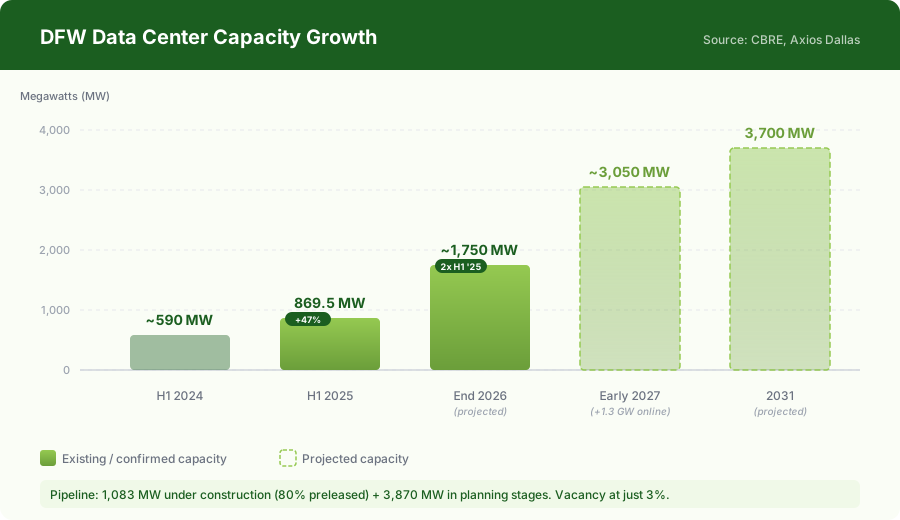
According to CBRE’s H1 2025 North America Data Center report, the total existing data center inventory in Dallas-Fort Worth increased 47% to 869.5 MW in just the first half of 2025. Net absorption for that same period hit 575 MW — a surge that dwarfed anything in 2023 or 2024. Vacancy sits at just 3%, and the under-construction pipeline is 80% preleased, driven almost entirely by hyperscaler and AI provider demand.
DFW’s data center inventory will more than double by end of 2026, with over 605 MW under construction. — Axios Dallas
The pipeline behind that is even larger: 1,083 MW under construction and another 3,870 MW in the planning stages, according to CBRE. Another 1.3 gigawatts are slated to come online around the beginning of 2027. By 2031, the market is expected to reach a total 3.7-gigawatt footprint. DFW is already the #2 data center market in North America, and Fort Worth Report notes that Texas is expected to become the world’s largest data center market by 2030.
The Corporate Migration Wave
The data center story is only half of it. CultureMap Dallas reports that 100 companies moved their headquarters to DFW between 2018 and 2024 — more than any other U.S. metro. In 2024 alone, 96 companies announced headquarters moves nationwide, up from just 18 in 2023, and DFW captured the lion’s share. Notable arrivals include Charles Schwab, CBRE, McKesson, Toyota North America, and Caterpillar, with Goldman Sachs building an 800,000-square-foot campus.
The Dallas Regional Chamber called 2025 “a defining year for economic momentum,” and the Bureau of Labor Statistics confirmed DFW added approximately 46,800 jobs over the year through mid-2025. Fort Worth alone added over 20,000 new tech jobs, with growth concentrated in AI, cybersecurity, and cloud computing roles.
What This Means for IT Disposal
Every new data center that comes online means older equipment being rotated out as capacity shifts. Every corporate relocation leaves an office full of IT equipment at the origin location — and generates a hardware procurement cycle at the destination that will itself create disposal needs in three to five years. Every AI infrastructure buildout displaces existing general-purpose servers that still have years of useful life left but no longer fit the performance profile.
DFW is generating more retired IT equipment per year than at any point in its history. And the wave is just beginning.
The Global E-Waste Context
The DFW story doesn’t exist in a vacuum. It’s the local expression of a global problem that’s growing faster than anyone’s ability to manage it.
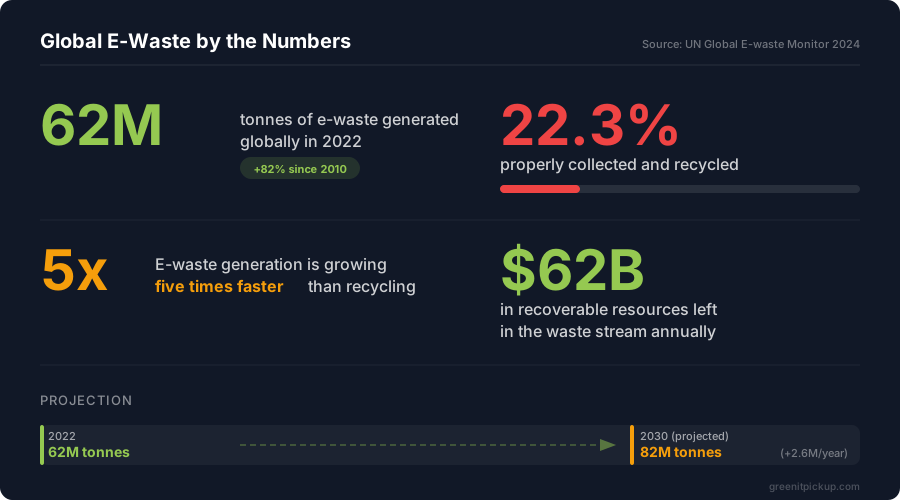
The UN Global E-waste Monitor 2024 — the most comprehensive global assessment of electronic waste — found that the world generated 62 million tonnes of e-waste in 2022, an 82% increase from 2010. Only 22.3% of that was properly collected and recycled. The rest — containing an estimated $62 billion in recoverable natural resources including gold, copper, and rare earth elements — ended up in landfills, was informally processed under unsafe conditions, or simply disappeared from the documented waste stream.
E-waste generation is growing five times faster than documented recycling capacity. — United Nations / ITU
The trajectory is not improving. The UN projects global e-waste will reach 82 million tonnes by 2030, rising at a rate of 2.6 million tonnes annually. To put the 2022 figure in perspective: 62 million tonnes would fill 1.55 million 40-tonne trucks — enough to form a bumper-to-bumper line encircling the equator.
The market responding to this problem is growing accordingly. The global e-waste management market is projected to reach approximately $91.5 billion in 2026, growing at a 13.3% compound annual rate according to Research and Markets. The IT asset disposition (ITAD) segment specifically is expected to reach $26.8 billion in 2026, growing at roughly 8.5% annually and projected to exceed $44 billion by 2032 (Research and Markets).
Texas — and DFW specifically — sits at the intersection of all these trends. We’re one of the fastest-growing technology markets in the world, inside a state with minimal e-waste regulation, producing equipment at unprecedented scale. The question isn’t whether DFW has an IT disposal challenge. It’s whether the local infrastructure can keep pace with it.
The Texas Regulatory Landscape
This is an area where most DFW businesses are operating with incomplete information — and where that gap creates real risk.
What Texas Does (and Doesn’t) Require
Unlike California, New York, and roughly two dozen other states, Texas has no statewide ban on electronics in landfills. The Texas Commission on Environmental Quality (TCEQ) oversees two manufacturer-focused recycling programs — Texas Recycles Computers and Texas Recycles TVs — but these are consumer programs, not business programs. They don’t apply to the enterprise-grade servers, switches, storage arrays, and data center infrastructure that makes up the bulk of B2B IT disposal.
For businesses, the regulatory framework is a patchwork. Federal RCRA (Resource Conservation and Recovery Act) and EPA Universal Waste Rules govern the hazardous components found in electronics — batteries, mercury-containing displays, CRT lead, certain circuit board materials. Some electronics, including circuit boards and batteries, can test as hazardous waste, which triggers costly handling, storage, and transport requirements under TCEQ rules.
According to ERI’s 2026 compliance outlook, no significant federal ITAD regulation is expected this year, meaning states will continue setting their own standards — or, in Texas’s case, largely declining to set them.
The Compliance Requirements That Do Exist
The absence of a dedicated e-waste law does not mean businesses can dispose of IT equipment however they choose. For organizations handling sensitive data — which in 2026 is nearly every organization — federal industry regulations create de facto disposal requirements that are far more demanding than any state environmental law:
HIPAA requires healthcare organizations to render protected health information unrecoverable before disposing of any media. PCI-DSS mandates secure destruction of cardholder data. SOX and GLBA impose data retention and destruction requirements on financial institutions. Even organizations not in regulated industries face exposure under state data breach notification laws and contractual data protection obligations.
The practical reality is this: the absence of strict state environmental regulation doesn’t mean businesses can do whatever they want. It means the burden falls on the organization to demonstrate responsible handling — and that documentation, not just intention, is what matters in an audit or a breach investigation.
Texas Right to Repair
One notable regulatory development: Texas passed a Right to Repair law taking effect September 1, 2026, requiring manufacturers of consumer electronics priced over $50 to provide replacement parts, tools, and repair documentation to consumers and independent repair shops. Governor Abbott became the first Republican governor in the U.S. to sign such a bill. While the law targets consumer electronics and doesn’t directly apply to enterprise IT equipment, it signals a broader cultural shift toward extending hardware lifecycles and reducing premature disposal — a principle that applies equally to business IT assets.
What We’re Seeing on the Ground
Market data and regulatory frameworks only tell part of the story. As a local operator running pickups across the DFW Metroplex every week, we see the trends playing out in real time — and some of them aren’t captured in any analyst report.
The Equipment Mix Is Shifting
Three to five years ago, a typical pickup was heavy on traditional 1U and 2U rack servers and desktop PCs. The hardware was familiar and predictable. That’s changed. We’re now seeing significantly more hyperconverged infrastructure nodes, GPU-accelerated servers being rotated out after relatively short service windows, and massive quantities of laptops from organizations still consolidating their post-COVID hybrid work footprints. The variety of equipment coming through in a single pickup has expanded dramatically.
Refresh Cycles Are Accelerating
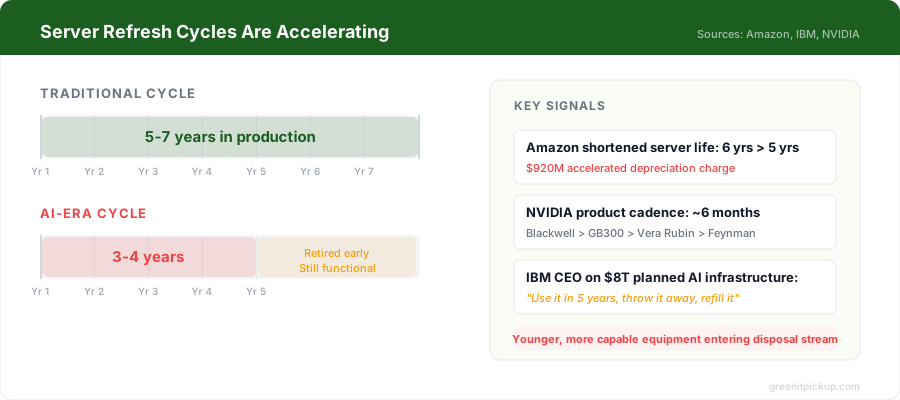
This is perhaps the most significant shift we’re observing. AI workloads are pushing enterprises to retire perfectly functional general-purpose servers in favor of GPU-optimized hardware. Equipment that would have run five to seven years is being pulled at three to four.
The data supports this at the macro level. Amazon shortened the useful life for a subset of its servers from six years to five in early 2025, citing the pace of AI development and taking a $920 million accelerated depreciation charge. NVIDIA’s roadmap has moved to a near-six-month cadence — Blackwell to GB300 to Vera Rubin to Feynman — and each generation shift means the previous one becomes economically suboptimal. IBM CEO Arvind Krishna went further, warning publicly that five-year refresh cycles on $8 trillion of planned AI data center infrastructure create a compounding capex problem that may be unsustainable.
What this means locally: there is a growing stream of enterprise-grade equipment — servers, networking, storage — hitting the secondary market in DFW that is younger, more capable, and more valuable than what we saw even two years ago. Organizations that act quickly on disposal capture more residual value. Those that let equipment sit in closets watch that value depreciate month by month.
The Closet Problem
Many DFW businesses are sitting on years of accumulated IT equipment they never got around to disposing of properly. Office closets. Under-desk storage areas. Forgotten server rooms that haven’t been powered on since the office reopened after COVID. We see this on nearly every first-time pickup — the request is usually for a current batch of retired equipment, but then we discover two or three previous generations stacked up behind it.
The longer equipment sits, the less residual value it retains and the greater the data security risk from drives that were never properly sanitized. A three-year-old server is worth meaningfully more on the secondary market than a five-year-old server. And every unwiped drive in a storage closet represents a potential data exposure that no one is tracking.
Data Anxiety Is Real — But Often Misplaced
When we talk with IT managers about equipment disposal, the conversation almost always starts with data destruction. The concern is legitimate. But many organizations don’t realize that professional digital sanitization following NIST 800-88 guidelines — which involves cryptographic erasure or multi-pass overwrite with verification — is sufficient for the vast majority of business use cases. We provide certificates of data sanitization documenting the process for every drive we handle.
Physical destruction — shredding, degaussing — is available as a paid add-on and is appropriate for highly sensitive environments. But for standard business data, it’s typically overkill. The important thing is having a documented, verifiable process. The method matters less than the fact that you can prove it happened.
The Mid-Market Gap
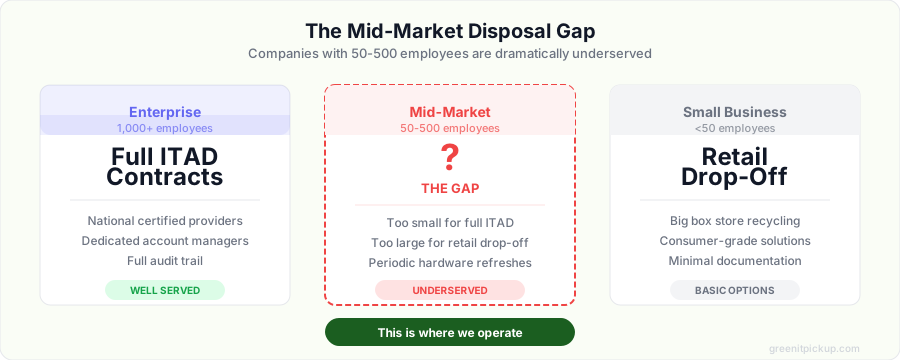
Enterprise companies with 1,000+ employees typically have established ITAD contracts with national providers. Small businesses with five computers take them to a retail drop-off. But the mid-market — companies with 50 to 500 employees doing periodic hardware refreshes — is dramatically underserved. These organizations don’t need (or want to pay for) full-service ITAD with per-device processing fees and certified destruction chains. But they need something better than letting drives accumulate in a closet or, worse, ending up in a dumpster. That middle ground — professional pickup, documented digital sanitization, responsible downstream handling — is exactly where we operate, and where we see the most unmet demand across the Metroplex.
The Economics of IT Equipment Disposal in DFW
Understanding the cost landscape helps explain why so much equipment ends up sitting in closets instead of being properly handled. Here’s how the primary options break down for a typical DFW business:
Full-service ITAD providers charge $10–25 per drive for certified destruction, plus per-device processing fees, logistics surcharges, and often minimum engagement thresholds. For a company retiring 50 servers with multiple drives each, you’re looking at a four- to five-figure engagement. This makes sense for highly regulated industries — healthcare, financial services, government — where the documentation requirements justify the cost. For a midsize company doing a routine office refresh, it’s often more than the budget allows. (See our detailed comparison of IT recycling vs. full ITAD.)
National recycling chains often offer free services but can be opaque about what happens downstream. Documentation is limited. Chain of custody may be unclear. Equipment sometimes gets shipped overseas for processing under conditions the original owner can’t verify or control.
Local IT recyclers — our model — offer free pickup with digital sanitization included at no charge. Equipment with residual value gets refurbished and resold through our enterprise hardware division, which subsidizes the service cost. Physical destruction is available as a paid add-on when required. The advantages are fast turnaround, a local chain of custody you can verify, and documentation that holds up to audit. (See our cost breakdown for hard drive destruction options.)
DIY / Do nothing is the hidden expensive option. The costs are real but spread out and invisible: square footage consumed by stored equipment, security liability from unwiped drives, depreciation of resale value (equipment loses 15–25% of its secondary market value per year), and compliance exposure that compounds over time. For a company sitting on a closet full of old servers, the true cost of inaction almost always exceeds the cost of any professional disposal option.
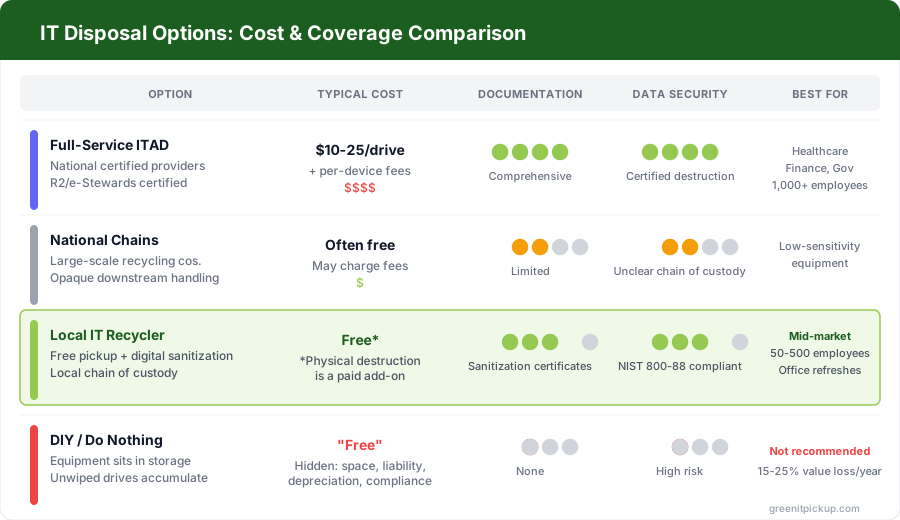
The key insight for most DFW businesses: the right answer is somewhere between “do nothing” and “pay $15,000 for certified ITAD.” That middle ground exists, and it doesn’t have to cost anything.
Looking Ahead: 2026–2027 and Beyond
Based on the data and what we’re seeing operationally, here’s where we expect the DFW IT disposal market to head over the next 12 to 24 months.
The data center construction wave guarantees a corresponding disposal wave. The 1,083 MW currently under construction and 3,870 MW in planning will generate first-generation equipment refreshes within three to five years. DFW is building the infrastructure today that will produce a massive equipment retirement cycle in the 2028–2031 timeframe. Organizations involved in data center decommissioning should be planning their end-of-life strategies now, not when the hardware is already racked.
AI hardware turnover will accelerate, not stabilize. GPU servers have fundamentally shorter useful economic lives than traditional compute. NVIDIA’s near-six-month product cadence and the competitive pressure from AMD, Intel, and custom silicon from the hyperscalers mean that the “latest generation” advantage degrades faster than it ever has. IBM’s CEO put it bluntly: you have to use it in five years because then you throw it away and refill it. That creates a continuous stream of high-value retired equipment that didn’t exist five years ago.
Texas’s regulatory environment will remain hands-off at the state level. Nothing in the current legislative landscape suggests comprehensive e-waste regulation is coming to Texas soon. Municipal programs may expand, but the practical reality for businesses is that self-governance remains the standard. Organizations that build documented disposal processes now — rather than waiting for regulation to force the issue — will be ahead of the curve.
Demand for documented data sanitization will continue to grow. As organizations become more data-aware, more cyber-insured, and more audit-exposed, the expectation for verifiable disposal documentation is becoming standard. The question is shifting from “did you wipe the drives?” to “can you prove it?” We see this in every conversation with IT managers — documented data sanitization is no longer a nice-to-have.
The ITAD market isn’t slowing down. At a projected 8–10% annual growth rate through 2032, the disposal challenge is only going to get bigger. The organizations, service providers, and regulatory frameworks that adapt to this reality will be the ones that keep DFW’s IT ecosystem functioning responsibly as it continues to scale.
The Bottom Line
Dallas-Fort Worth is generating unprecedented volumes of retired IT equipment. That’s not a temporary condition — it’s a structural feature of a regional economy that has positioned itself as a national center for technology infrastructure, corporate operations, and AI compute.
Responsible disposal isn’t just an environmental consideration, though the global e-waste numbers make clear that it should be. It’s a data security issue: every unwiped drive in a storage closet is an unmanaged risk. It’s a compliance issue: HIPAA, PCI-DSS, and SOX don’t have carve-outs for “we meant to get to it.” It’s increasingly a financial issue: equipment sitting idle loses value every month, and the square footage it occupies has a cost too.
The good news is that for the vast majority of DFW businesses, responsible IT equipment disposal doesn’t have to be expensive or complicated. It starts with a conversation.
If your organization is planning a hardware refresh, an office move, or a data center decommission in the Dallas-Fort Worth area, we’d welcome the conversation. We serve 22 cities across the Metroplex, and pickup is free for qualifying businesses.
Sources
- CBRE — North America Data Center Trends H1 2025: Dallas-Ft. Worth
- Axios Dallas — Dallas-Fort Worth data center market to double by 2026
- Fort Worth Report — Texas expected to be world’s largest data center market by 2030
- CultureMap Dallas — DFW tops U.S. list for corporate HQ relocations
- Dallas Regional Chamber — A Defining Year for DFW’s Economic Momentum
- U.S. Bureau of Labor Statistics — Dallas-Fort Worth Area Employment, May 2025
- UN Global E-waste Monitor 2024
- ITU — Global e-waste reaches 62 million tonnes
- Research and Markets — E-Waste Management Market Report 2026
- Research and Markets — IT Asset Disposition Market Size & Forecast
- Texas Commission on Environmental Quality — Electronics Recycling Regulations
- ERI — New Year, New Compliance Risks: Electronics Disposal Rules to Watch in 2026
- Waste Dive — Texas approves Right to Repair for electronics
- Tom’s Hardware — IBM CEO warns trillion-dollar AI data center buildout is unsustainable
- TechRadar — IBM CEO on AI data center hardware refresh cycles