
How Much Should This Cost?
At some point, every IT manager stares at a pile of retired equipment and asks the same question: what’s this going to cost us to get rid of?
The honest answer is that ITAD pricing is one of the least transparent corners of the IT services industry. Most providers require a custom quote. Costs can range from “we’ll actually pay you for this equipment” to “$15,000+ for a single project.” The variables — equipment type, volume, data sensitivity, compliance requirements, logistics complexity — make it genuinely difficult to compare options without understanding the underlying cost structure.
This post is our attempt to lay that structure bare. Not to sell you on any particular approach, but to give you enough information to evaluate your options honestly. Because the right answer for a 50-person marketing agency in Plano is different from the right answer for a 500-bed hospital system in Fort Worth — and neither of them should be paying for services they don’t need.
The ITAD Cost Spectrum: Four Models
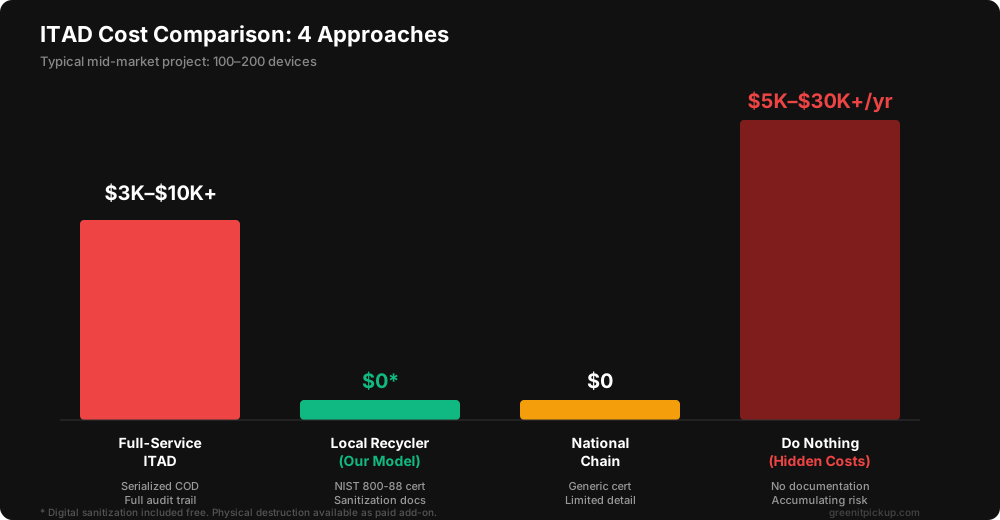
There are fundamentally four ways DFW businesses handle retired IT equipment. Each has a different cost profile, a different level of documentation, and a different set of tradeoffs.
Model 1: Full-Service National ITAD ($$$)
The enterprise-grade option. Companies like Iron Mountain, Sims Lifecycle Services, and CDW’s ITAD division operate large-scale processing facilities with extensive compliance infrastructure. They hold certifications like R2, e-Stewards, and NAID AAA — and you’re paying for the overhead that maintains those certifications.
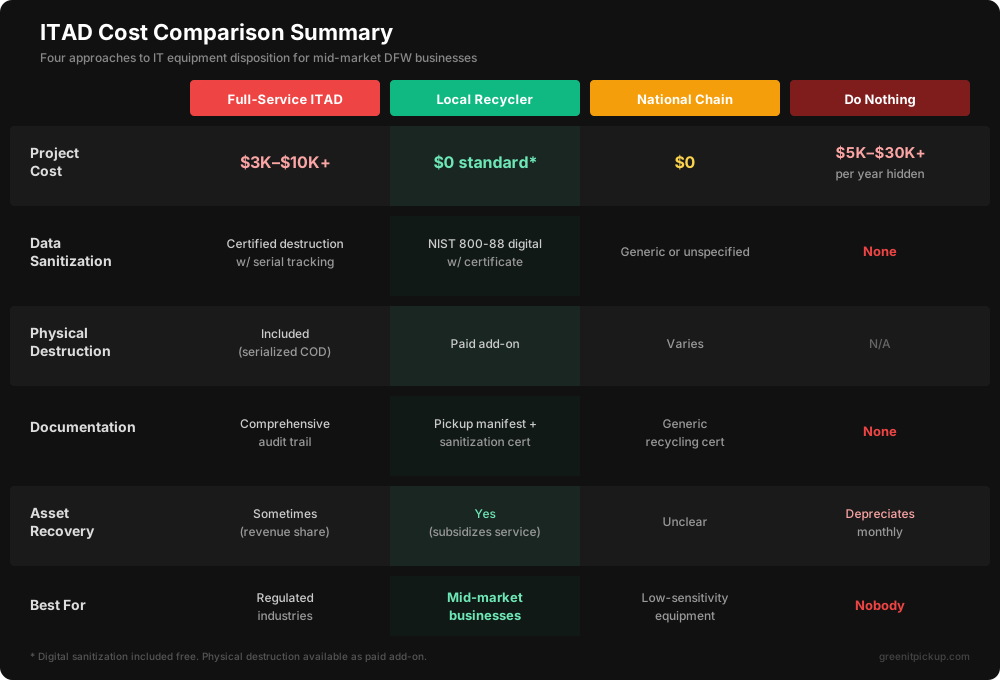
The cost structure is layered. Per-device processing fees typically run $10-30 per device depending on type and complexity. Certified hard drive destruction adds $8-25 per drive for physical shredding with serial number tracking. On top of that, expect logistics charges (pickup fees, per-pallet rates, project management), documentation fees for serialized certificates of destruction, and often minimum engagement thresholds that make small projects disproportionately expensive.
For a typical mid-market project — say, 100-200 devices from an office refresh — total costs generally land in the $3,000-$10,000+ range depending on the mix of equipment and the level of documentation required. An ITAD industry guide from Inventory Recovery provides a useful overview of how these costs stack up across providers. SmartWaste’s pricing guide offers additional context on the fee structures common across the industry.
Best for: Regulated industries — healthcare organizations navigating HIPAA, financial institutions under PCI-DSS and SOX, government contractors with CMMC requirements — where formal chain-of-custody documentation and serialized destruction certificates are non-negotiable. Also appropriate for large enterprises (1,000+ employees) that need ongoing ITAD contracts with quarterly or monthly pickups.
Model 2: Local IT Recycler with Data Sanitization ($ or Free)
This is our model, so we’ll be transparent about how it works.
Local IT recyclers offer free pickup for qualifying businesses with sufficient equipment volume. Digital sanitization following NIST 800-88 guidelines is included at no charge — drives are sanitized using software-based methods (Clear and Purge levels) with verification. Certificates of data sanitization are provided documenting the process. Physical destruction (shredding, degaussing) is available as a paid add-on when compliance specifically requires it.
The economics of free pickup work because retired IT equipment isn’t worthless — functional hardware has a secondary market, and responsible reuse generates more value than raw material recycling. That’s what makes it possible to offer free pickup and sanitization for qualifying businesses. It’s a model that works for everyone: you get your equipment handled at no cost, and functional hardware stays in productive use instead of being shredded.
Total cost for a typical mid-market project: $0 for standard service. Add-on costs apply for physical destruction, expedited documentation, or specialized handling requirements.
Best for: Mid-market businesses (50-500 employees) doing periodic hardware refreshes who need professional data handling and documentation without the overhead of a full-service ITAD contract. This covers the majority of DFW businesses we work with. For a deeper comparison of these two approaches, see our detailed analysis of IT recycling vs. full ITAD.
Model 3: National Recycling Chains (Free but Opaque)
Several national companies offer free electronics recycling with minimal friction. The pitch is appealing: call a number, schedule a pickup, done. No cost, no complexity.
The tradeoff is transparency. Many of these operations provide limited visibility into what happens after pickup. Equipment may be shipped to processing facilities in other states — or other countries — where handling practices are difficult to verify. Documentation is typically a generic recycling certificate rather than anything specific to your equipment or data. Data destruction guarantees, when offered, may be vague about methodology and verification.
Total direct cost: $0. But the hidden cost is the documentation gap. If you’re ever audited on data handling practices or face a breach investigation, “we gave it to a recycler” without specific sanitization documentation is a weak position.
Best for: Businesses with genuinely no regulatory requirements and no sensitive data on their equipment — which, in practice, describes very few organizations in 2026.
Model 4: Do Nothing ($$$$$ Over Time)
The “store it in the closet” approach deserves its own section, because its costs are real but invisible — which is exactly what makes it dangerous.
Cost Comparison Summary
The Real Cost of Doing Nothing
This is where most DFW businesses are actually losing money — they just don’t see it because the costs are distributed across line items that nobody connects to a pile of old servers in a storage room.
Office Space You’re Paying For
Average DFW Class B office space runs $20-30 per square foot per year. A 10x10 storage room dedicated to old equipment costs your business $2,000-$3,000 annually in wasted square footage. If you have multiple locations with their own equipment graveyards — which is common for companies with DFW branch offices — multiply accordingly. IITSTech’s analysis of hidden storage costs details how these seemingly small expenses compound into significant overhead.
That storage room could be a meeting room, a breakout space, or reclaimed into productive square footage. Instead, it’s a graveyard for equipment that loses value every month.
Asset Depreciation That Compounds
This is the cost most businesses underestimate because they don’t think of retired equipment as having value. It does — but only if you act while that value exists.
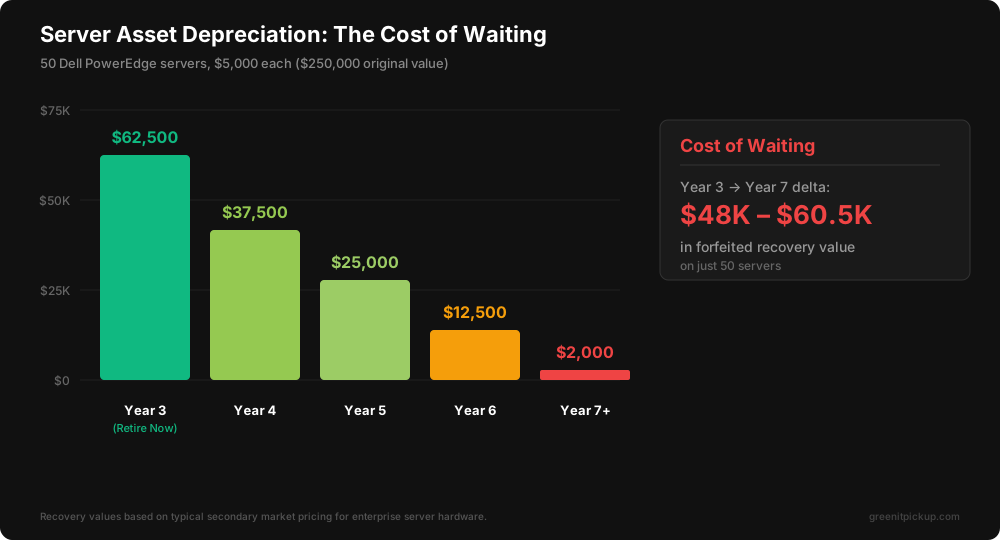
IT equipment can lose 60-80% of its secondary market value within two to three years of retirement, and the decline accelerates from there. A batch of servers that could have been handled responsibly and put back into productive use at year three may be worth nothing but scrap metal by year five or six. Every month of delay means the equipment’s potential for reuse diminishes — and the environmental benefit of keeping it in service disappears with it.
The practical takeaway: acting sooner is always better than acting later. Whether the value benefits you directly (through a buyback arrangement with an ITAD provider) or makes free pickup possible (through a local recycler’s service model), delay is the enemy.
Security Liability That Accumulates
Every unwiped drive sitting in a storage closet is an unmanaged data exposure. It’s not a theoretical risk — it’s a specific, quantifiable liability.
The average cost of a data breach continues to climb, with IBM’s annual Cost of a Data Breach report consistently showing figures in the $4-5 million range for U.S. organizations. HIPAA violations carry penalties of $100-$50,000 per violation, up to $1.5 million per year per violation category. Even organizations outside regulated industries face exposure under Texas’s data breach notification law and contractual data protection obligations.
HOBI’s analysis of IT asset hoarding risk makes the point clearly: stored equipment that hasn’t been sanitized isn’t retired — it’s dormant liability. The drives still contain whatever data they had when they were pulled from production. Every month they sit there is another month someone could walk out with them.
Administrative Burden Nobody Accounts For
IT staff time spent managing, inventorying, relocating, and fielding questions about stored equipment has a real cost. Compliance teams can’t audit what they can’t see — undocumented equipment in storage creates coverage gaps that may not surface until an audit or incident forces the question. Insurance policies that require accurate inventory of business property may have coverage implications for undocumented assets.
The key takeaway: The most expensive option for most DFW businesses isn’t paying for ITAD. It’s paying to store equipment that loses value every month while creating security and compliance liabilities that compound over time.
How to Evaluate What You Actually Need
Before requesting quotes or scheduling pickups, answer five questions. Your answers determine which model fits your situation.
1. What compliance frameworks apply to your organization? HIPAA, PCI-DSS, SOX, CMMC, FERPA, GLBA — each has different requirements for data handling and documentation. If you’re not sure, ask your compliance team or legal counsel. The answer to this question determines your minimum documentation threshold.
2. Do you need serialized certificates for individual drives, or is a batch certificate sufficient? Serialized certificates (individual tracking of each drive by serial number with destruction method and timestamp) are the gold standard for regulated industries. Batch certificates (documenting the sanitization process for a group of drives) are sufficient for most standard business use cases. The cost difference between these two levels is significant.
3. Does your data require physical destruction, or is NIST 800-88 digital sanitization sufficient? For the vast majority of business data, digital sanitization is the right choice — it meets federal standards and costs nothing with a qualifying pickup. Physical destruction is appropriate for classified data, failed drives, and specific regulatory mandates. Know your actual requirement before defaulting to the most expensive option.
4. Is your equipment recent enough to be reused? Newer equipment (servers less than five years old, recent-generation networking gear and laptops) has more potential for responsible reuse rather than material recycling. This matters environmentally — and it may affect which disposition options are available to you and at what cost.
5. Is this a one-time project or an ongoing need? A one-time office cleanout has different economics than a quarterly refresh cycle. Ongoing relationships with ITAD providers typically come with better per-unit pricing but also contractual commitments.
The decision guide is straightforward:
If you need serialized destruction certificates for regulated data → full-service ITAD is worth the investment.
If you need professional data sanitization with documentation for standard business data → a local recycler with NIST 800-88 capability handles this at zero or minimal cost.
If your equipment is all 10+ years old with no resale value → the value recovery ship has sailed, but you still need data sanitization and responsible recycling. Don’t let the absence of resale value be an excuse to keep hoarding.
The DFW Market Context
These cost dynamics exist against a backdrop of unprecedented IT equipment volume in Dallas-Fort Worth.
The global ITAD market is projected to grow from $21.77 billion in 2026 to $48.48 billion by 2034, representing a 10.53% compound annual growth rate according to GM Insights. That growth is driven by the same forces playing out locally: accelerating hardware refresh cycles, expanding compliance requirements, and growing awareness of e-waste environmental impact.
DFW specifically is at the center of this growth. As we detailed in our 2026 DFW market report, the region’s data center capacity is on pace to more than double by year-end, and corporate relocations continue to generate massive volumes of retiring equipment. The mid-market gap — companies with 50-500 employees caught between enterprise ITAD contracts and consumer recycling drop-offs — remains the most underserved segment in the DFW metroplex.
Making the Call
ITAD costs range from free to five figures depending on what you actually need. For most DFW businesses, the right answer isn’t the most expensive option or the cheapest one — it’s the one that matches your actual compliance requirements, captures whatever residual value your equipment holds, and gets documented well enough to withstand scrutiny.
The worst answer, by far, is no answer at all. Equipment sitting in closets is the most expensive option on the table — it just doesn’t show up on an invoice.
If you’re sitting on retired IT equipment in Dallas-Fort Worth and aren’t sure which model fits your situation, we’re happy to talk through the options. We provide free pickup with NIST 800-88-compliant digital sanitization for qualifying businesses across 22 DFW cities, and paid add-on services when your compliance needs require more. Whether that means a straightforward equipment pickup, a server decommission, or a full data center teardown — the first step is the same conversation.
Sources
- IT Asset Disposition (ITAD) Complete Guide 2025 — Inventory Recovery
- Understanding ITAD Service Pricing — SmartWaste
- The Hidden Costs of Storing Old IT Equipment — IITSTech
- IT Asset Hoarding: Why Storing Retired Devices Is Riskier Than You Think — HOBI
- IT Asset Disposition Market Size & Forecast — GM Insights