
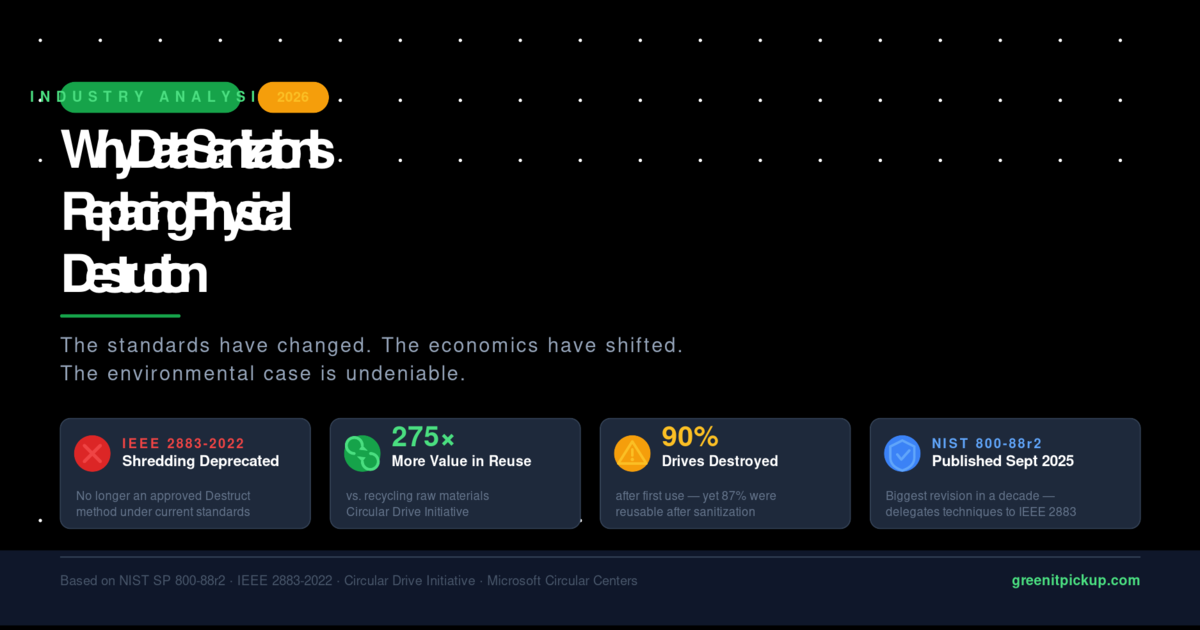
The End of “Just Shred Everything”
Drive shredding is familiar, but current NIST guidance does not say to shred every drive. It calls for a risk-based media sanitization program and a method appropriate to the media, data sensitivity, intended disposition, and the organization’s own requirements. That distinction is the reason this analysis is worth your time.
The IT industry is undergoing a fundamental shift in how it thinks about end-of-life data security. For decades, physical destruction — shredding, degaussing, incinerating — was the default approach to data-bearing media at end of life. It felt safe. Viscerally, undeniably safe. If you can hold a pile of metal fragments in your hand, you know the data is gone. That certainty made physical destruction the path of least resistance for IT directors, compliance officers, and C-suites alike.
But in 2026, standards guidance, reuse programs, ESG goals, and the economics all support asking a better question before destroying functional media: can an appropriate, validated sanitization technique protect the data while preserving the asset? The updated NIST SP 800-88 Rev. 2, published in September 2025, places that decision inside an organizational sanitization program. For technique-level detail, it directs readers to current sources such as IEEE 2883-2022, NSA specifications, or a standard accepted by organizational policy. Microsoft’s Circular Centers are recovering server components for reuse, while the Circular Drive Initiative argues that drive reuse can preserve far more environmental value than raw-material recycling alone.
This is no longer a niche technical debate. It is a strategic decision with security, financial, environmental, and compliance implications that touch every organization retiring IT equipment. The question isn’t whether to take data security seriously — it’s whether your approach reflects the current evidence or a decade-old assumption. When should you sanitize? When should you destroy? And why does the distinction matter more now than ever?
What the Standards Actually Say: NIST SP 800-88 Rev. 2 and IEEE 2883
Any serious discussion of data sanitization has to start with the standards, because the standards have changed more in the past two years than in the preceding decade.
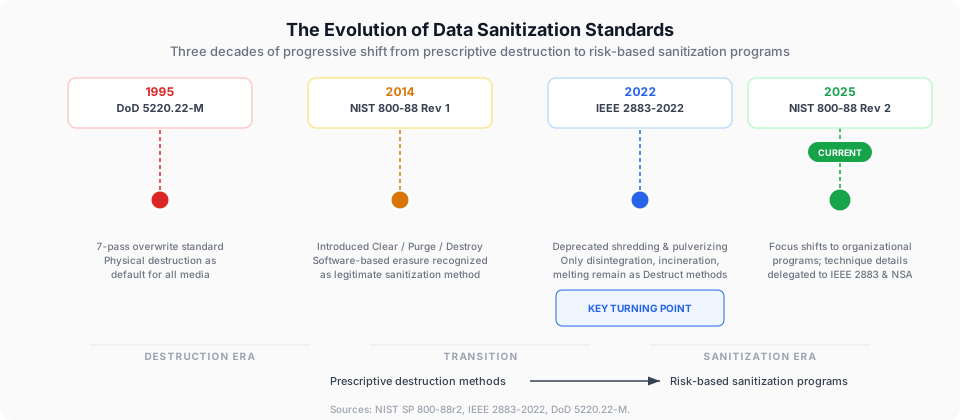
NIST Special Publication 800-88 Revision 2, published in September 2025, emphasizes organizational media sanitization programs: policies, risk assessments, method selection, documentation, verification, validation, and accountability. Its change log says that, apart from cryptographic erase, technique and tool details were replaced with recommendations to use IEEE 2883, NSA specifications, or an organizationally approved standard.
NIST continues to define three sanitization methods: Clear, Purge, and Destroy. It describes disintegration, incineration, and melting as techniques commonly associated with Destroy, but the controlling test is the outcome: recovery must be infeasible using state-of-the-art laboratory techniques. NIST does not make every shredder, crusher, or particle size universally acceptable or unacceptable. The organization must evaluate the technique, the media, the resulting fragments, and its governing policy against the applicable standard. NIST illustrates this point with an example in which shredding an optical disc into pieces larger than an organization’s limit fails validation even though the machine completed its cycle.
Purge also is not a blanket label for any software wipe. Depending on the media, NIST says acceptable logical Purge techniques can include overwrite, block erase, and cryptographic erase performed through dedicated, standardized device sanitization commands. Purge is designed to make laboratory recovery infeasible while potentially preserving the media for reuse, but the selected command, tool result, media health, verification, and validation all matter. NIST says Purge should be used instead of Clear when possible; it does not say Purge always replaces Destroy. Failed media, classified information, contractual requirements, and organizational policy can still make physical destruction the appropriate choice.
The Media-Fit Problem: Why One Method Does Not Fit Every Drive
There is a specific technical reality that every disposition plan has to address: a technique that is suitable for one storage technology may be unsuitable for another. Magnetic hard drives and solid-state storage require different media-aware decisions.
Hard disk drives store data on spinning magnetic platters. Degaussing can affect magnetic media, while crushing, shredding, and other destructive techniques physically damage the storage components. The equipment and output criteria still have to match the media and the organization’s applicable standard; breaking a housing is not by itself proof that laboratory recovery is infeasible.
Solid-state drives are a fundamentally different architecture. SSDs store data on NAND flash packages mounted on a printed circuit board. A destructive process must address those storage components and meet the output requirements selected for the project; damage to the enclosure or circuit board alone is not a sufficient validation criterion.
Degaussing is a clear example of why media identification matters. NIST says it should not be used for non-magnetic media such as SSDs. It also warns that a degausser may damage some magnetic media without sanitizing the target data if the device is not matched to the media’s coercivity. A service record proves that an action was documented; assurance comes from selecting a suitable technique and validating its outcome.
Cryptographic erase, block erase, and other dedicated device sanitization commands may be appropriate for compatible flash media, subject to the device implementation and the organization’s requirements. If a drive cannot complete a suitable command—or if policy requires destruction—the physical method should be scoped specifically for that media. GreenIT can provide witnessed on-site drive crushing for projects where that method fits the media and written requirements.
The Environmental Case: ESG, Circular Economy, and the True Cost of Shredding
The security argument for software-based sanitization is strong on its own terms. But the environmental dimension transforms this from a technical preference into a strategic imperative.
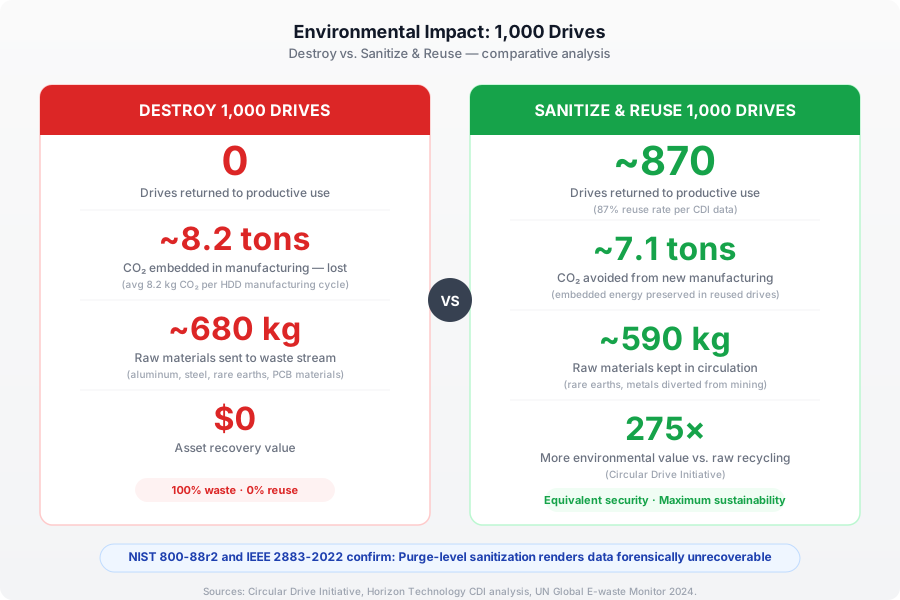
The scale of waste in the current model is staggering. According to the Circular Drive Initiative (CDI) — a consortium that includes Seagate and major data center operators, convened under circular economy pioneer William McDonough — data centers currently destroy up to 90% of storage devices after first use, primarily due to security concerns. Yet an estimated 87% of those drives are functionally reusable after proper sanitization. The CDI’s Data Sanitization Best Practices Guide, published in alignment with IEEE 2883, ISO 27040, and NIST SP 800-88 Rev. 2, makes the case that the industry’s default to destruction is creating an environmental problem that doesn’t need to exist.
The numbers put this in perspective. Horizon Technology’s analysis of CDI data found that reusing a drive has up to 275 times more environmental value than recycling its raw materials alone. That ratio captures the embedded energy of manufacturing — the rare earth mining, the semiconductor fabrication, the precision assembly — that is irretrievably lost when a functional drive is shredded.
The hyperscalers have already internalized this math. Microsoft’s Circular Centers program — operating across seven global facilities with new capacity planned in San Antonio, TX — achieved a 90.9% server and component reuse and recycling rate in 2024, a year ahead of their 2025 target. For drives that genuinely cannot be reused, Microsoft developed an acid-free HDD dissolution process through their #NoShred initiative that recovers 90% of elemental and rare-earth materials with an estimated 95% reduction in emissions compared to traditional mining and processing. The signal from the largest technology companies in the world is unambiguous: destruction as a default policy is obsolete.
The broader e-waste context makes this urgency clear. The UN Global E-waste Monitor 2024 reported 62 million tonnes of e-waste generated globally in 2022, with only 22.3% properly collected and recycled. E-waste is growing five times faster than recycling capacity. The global e-waste market is valued at $62.96 billion in 2026, projected to reach $85.9 billion by 2030 at an 8.1% CAGR. Data storage and transmission alone contribute approximately 330 megatons of CO2 annually — roughly 2% of global emissions.
For organizations with ESG reporting obligations, this creates both risk and opportunity. Metrics like devices reused, materials recovered, and estimated emissions avoided can support sustainability disclosures when the methodology is documented. Every drive that can be securely sanitized and reused instead of unnecessarily destroyed is an opportunity for the environment, the circular economy, and the organization’s own sustainability goals. When a media-appropriate technique is successfully validated against the organization’s requirements, reuse can become a defensible security and environmental choice.
The Financial Case: Destruction Is the Most Expensive Option
The environmental argument resonates with sustainability teams. The financial argument resonates with everyone else.
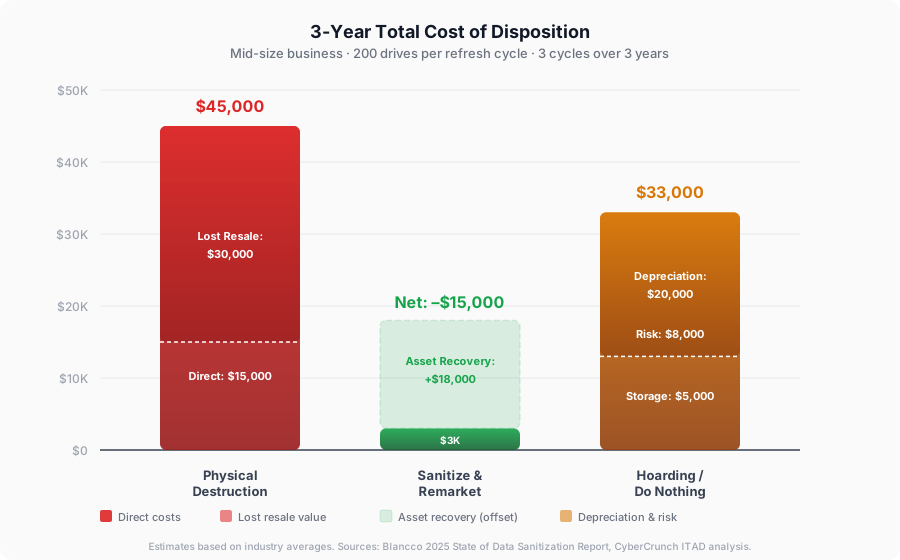
The economics of physical destruction are straightforward — and unfavorable. Certified shredding typically runs $10–25+ per drive, with additional per-device processing fees, transportation costs, and certificate-of-destruction documentation. For a mid-size enterprise retiring 200 drives per cycle, that’s $2,000–$5,000 in direct destruction costs alone, with zero asset recovery. Every destroyed drive represents not just the cost of destruction but the forfeiture of whatever resale value that equipment carried.
Software-based sanitization inverts this equation. Sanitization can be performed in-house or by a local ITAD operator at significantly lower cost — and in many cases, it’s included as part of free equipment pickup services for qualifying volumes. More importantly, sanitized drives remain functional and retain their market value. Organizations implementing data wiping programs commonly achieve asset recovery revenues covering 40–60% of total ITAD program costs. The Blancco 2025 State of Data Sanitization Report found that destroying functional devices costs large enterprises over $1 million every three years, with an additional $1.1 million in lost resale value — a combined impact exceeding $2 million per refresh cycle.
There is a third option that many organizations practice without acknowledging it: doing nothing. Drives sit in storage closets, accumulate in IT cages, and pile up in warehouses. The hidden costs of hoarding include storage space, ongoing security liability from unwiped drives, steady asset depreciation (a three-year-old drive is worth meaningfully more than a five-year-old drive), and cumulative compliance exposure from sensitive data that was never properly sanitized. Hoarding is not a strategy — it’s deferred risk.
When a DFW business hands us a rack of Dell PowerEdge servers that were running production workloads last month, those servers can have real market value. We sanitize their storage media using a process aligned with NIST SP 800-88 Rev. 2 guidance, can provide GreenIT-issued service documentation, and prioritize productive reuse when equipment is suitable. If those same servers had been destroyed unnecessarily, the reusable equipment and its embedded manufacturing value would be lost.
When Physical Destruction IS the Right Call
Intellectual honesty requires acknowledging that physical destruction is not obsolete — it’s narrower in application than most organizations assume. There are scenarios where destruction is not just appropriate but required, and any responsible analysis must delineate those boundaries clearly.
Classified government data sits at the top of this list. Organizations handling classified material must follow the applicable NSA, agency, and contract requirements rather than applying general commercial guidance.
Drives with hardware failures present a straightforward practical constraint. If a drive will not power on, be recognized by a host system, or complete an appropriate sanitization routine, a destructive technique may be the practical option. NIST specifically identifies failed and obsolete media as cases in which destruction may be necessary.
Specific contracts and written policies may require physical destruction or name an exact technique. Those requirements control the project unless the responsible organization formally changes them. The obligation is to read the actual requirement, not assume that every regulated record must be destroyed in the same way.
Self-encrypting drives where encryption was never enabled represent an often-overlooked edge case. Cryptographic erasure works by destroying the encryption key, rendering the encrypted data unrecoverable. But if a self-encrypting drive was deployed without encryption ever being activated, there is no key to destroy. Overwrite or physical destruction becomes necessary.
Finally, there is the matter of organizational risk tolerance. Some organizations, regardless of what the standards say, maintain a zero-tolerance policy toward any residual risk from software-based methods. That is their prerogative, and it’s a defensible position when made deliberately. The point is not that destruction is wrong — it’s that destruction should be deployed based on a documented risk assessment, not as a blanket policy born from a decade-old assumption that shredding is the only “real” way to handle data.
The Decision Framework: A Practical Guide
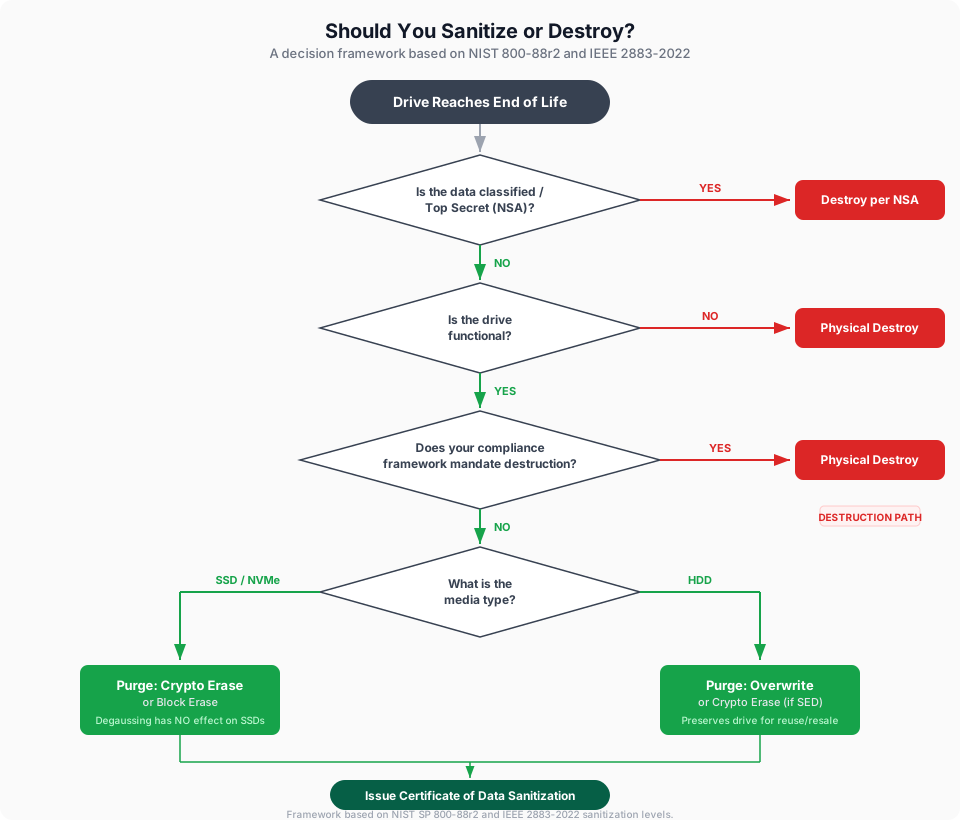
The preceding analysis distills into a practical decision framework that any organization can apply to its end-of-life media. Six factors determine the appropriate sanitization method for a given device.
Factor 1: Data classification. What is the sensitivity level of the data on the drive? Public and internal data have different risk profiles than confidential, regulated, or classified information.
Factor 2: Media type. Is this an HDD, SSD, NVMe drive, tape, or optical media? The effective sanitization methods differ significantly by technology.
Factor 3: Drive functionality. Can the drive power on and complete a sanitization routine? Non-functional media cannot be software-sanitized.
Factor 4: Encryption status. Was encryption enabled on a self-encrypting drive? If so, cryptographic erasure is the fastest and most efficient Purge method available.
Factor 5: Compliance requirements. What does your specific regulatory framework require — HIPAA, PCI-DSS, SOX, CMMC, or others? Requirements vary, and assumptions are not substitutes for verification.
Factor 6: Residual value. Does the equipment have meaningful resale or reuse value? This factor doesn’t affect the security decision, but it affects the total cost of the disposition decision.
| Scenario | Recommended Method | Rationale |
|---|---|---|
| Standard business data on functional HDD | Evaluate an applicable Purge technique | A suitable dedicated command may meet the required assurance while preserving the drive for reuse |
| Standard business data on functional SSD | Evaluate crypto erase or block erase | Media-appropriate device commands may preserve reuse; degaussing is not suitable for flash media |
| Regulated data on functional media | Appropriate Purge method with process documentation | Confirm the method and documentation against your specific legal, contractual, and policy requirements |
| Failed or non-functional drive | Evaluate an applicable destructive technique | A device command may be unavailable or unable to complete |
| Government classified data | Follow applicable NSA and agency requirements | General commercial guidance is not a substitute for the controlling requirements |
| Equipment with significant resale value | Sanitize and remarket when requirements allow | Financial and environmental upside after successful verification and validation |
What This Means for DFW Businesses
Dallas-Fort Worth is not a passive observer of these industry shifts — it is at the epicenter. DFW is the second-largest data center market in North America, with 605+ megawatts of capacity under construction and inventory projected to more than double by the end of 2026. That expansion means an unprecedented volume of storage media rotating out of production environments and into the disposition pipeline.
Beyond the data center market, DFW has ranked as the number one metro in the nation for corporate headquarters relocations, attracting 100 new corporate headquarters between 2018 and 2024 — including major moves like KFC’s global headquarters to Plano and continued inbound momentum heading into 2026. Relocations and refreshes generate equipment that needs responsible disposition at both the origin and destination. Mid-market companies without a dedicated ITAD program can easily default to “shred it” without first documenting the data, media, reuse potential, and policy requirements.
Local operators like GreenIT Pickup exist to close that gap. We provide NIST SP 800-88 Rev. 2-aligned digital sanitization as part of our free equipment pickup service across 26 cities in the DFW metroplex. For many compatible, functional devices, an appropriately scoped sanitization process can support both data protection and reuse.
Conclusion: The Standards Have Moved — Has Your Policy?
The direction is clear. NIST SP 800-88 Rev. 2 treats media sanitization as an organizational program, not a one-size-fits-all machine or command. IEEE 2883-2022 provides technique-level requirements that organizations should consult alongside their own policy and any applicable NSA specifications. The Circular Drive Initiative has quantified the environmental cost of unnecessary destruction, large operators have demonstrated reuse at scale, and the economics favor preserving functional equipment whenever the security decision permits it.
Physical destruction still has a role. It will always have a role — for classified data, for failed media, for specific contractual or policy mandates, and when a validated non-destructive technique is unavailable. But that role may be narrower than a blanket destruction policy assumes, and default destruction can carry avoidable financial and environmental costs. The useful question is not whether one method is always best. It is whether the selected method fits the media, data sensitivity, intended disposition, applicable requirements, and the organization’s accepted residual risk.
If your organization is evaluating data sanitization options in the Dallas-Fort Worth area — whether for a hardware refresh, an office move, or a data center decommission — we’re happy to walk through the options. We provide NIST SP 800-88 Rev. 2-aligned digital sanitization and can provide GreenIT-issued service records describing the process performed. Those records are not NIST approval or third-party certification. Reach out to start the conversation.
Sources
- NIST SP 800-88 Revision 2 — Guidelines for Media Sanitization
- NIST Publishes SP 800-88r2 (September 2025)
- IEEE 2883-2022 Standard for Sanitizing Storage
- Understanding IEEE 2883-2022: Clear, Purge, and Destruct Explained — SKTES
- An Introduction to the New IEEE Data Era Standard — Blancco
- IEEE Standards for Data Sanitization — Horizon Technology
- What Makes Crypto-Erase So Popular — Seagate
- Cryptographic Erasure: Is It a Secure Option? — Jetico
- Circular Drive Initiative
- CDI Publishes Data Sanitization Best Practices Guide — EIN Presswire
- Circular Drive Initiative: Sustainable Data Storage — Horizon Technology
- Microsoft’s Circular Economy Revolution in Data Centres — Data Centre Magazine
- Saving the Planet One Hard Drive at a Time — Microsoft Garage
- The Sustainable Choice: Data Wiping Over Physical Destruction — CyberCrunch
- 2025 State of Data Sanitization Report — Blancco
- Cutting the Carbon Footprint of Enterprise Data Storage — Blancco
- UN Global E-waste Monitor 2024
- Electronic Waste Business Report 2026 — GlobeNewsWire
- Why eSmart Recycling Is Key to Your 2026 ESG Strategy
- Dallas-Fort Worth Data Center Market to Double by 2026 — Axios
- Data Erasure Solutions Market — Business Research Insights
- Data Erasure Solutions Market — Mordor Intelligence
Need IT Equipment Picked Up?
GreenIT Pickup provides free onsite pickup for qualifying B2B IT equipment loads across the Dallas-Fort Worth metroplex, so your team does not have to transport equipment to a drop-off.
Related Services
Related Articles
Data Center Decommission Prep Guide
From a DFW equipment pickup partner: what IT teams should have buttoned up before scheduling a data center decommission pickup — and what happens when they don't.
Industry InsightsThe IT Closet Problem: Hidden Costs
That closet full of old servers and laptops isn't just taking up space — it's costing you money, creating security liabilities, and losing value every month. Here's the math.
Industry InsightsITAD Cost Breakdown for DFW Businesses
Compare ITAD costs for DFW businesses, including enterprise vendors, local pickup, data handling, logistics and the hidden cost of storing retired equipment.