
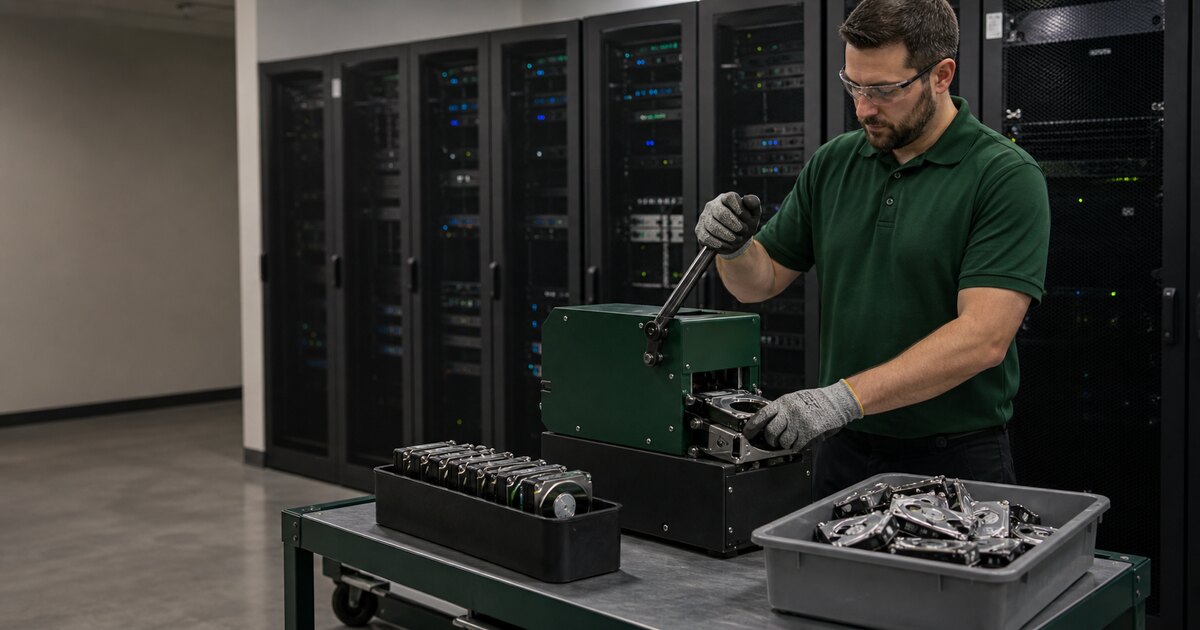
Some organizations are comfortable releasing functional drives for a documented sanitization process. Others have a written rule: selected media must be physically destroyed, an employee must watch, and the project file must show exactly what happened to each drive.
GreenIT Pickup can bring a portable drive crusher to an approved Dallas-Fort Worth location. Authorized customer personnel can witness the physical destruction, and the agreed documentation package can follow each covered drive from serial-number capture to a verifiable PDF.
We call the method drive crushing, not shredding. People often search for “mobile hard drive shredding,” but a portable crusher physically deforms the drive rather than cutting it into small particles. The method and supported media are confirmed before scheduling.
What happens during a documented onsite crushing project?
Scope before arrival
The planning call should establish:
- approximate drive count;
- HDD, SSD, NVMe, flash, tape, or embedded-media types;
- who is authorized to witness;
- whether the media must remain in a controlled room;
- access, parking, loading, and safety restrictions;
- required evidence fields;
- equipment being released with the drives.
One machine is not automatically appropriate for every storage technology. Media construction matters, and the customer’s written policy matters.
Serial number and before photo
Each covered drive can be identified by serial number and photographed before physical destruction. This ties the evidence to a particular device instead of producing one generic statement for a whole pile.
The quality of the source inventory still matters. If an internal asset record expects 42 drives and only 41 arrive at the crushing station, the gap should be resolved rather than hidden behind a certificate.
Witnessed crushing
The portable crusher is operated at the customer location. The drive is physically deformed while the authorized observer can see the work being performed.
Physical destruction does not erase the need for process control. Drives awaiting destruction should remain organized, and destroyed media should be separated from the pending queue so the evidence does not become ambiguous.
After photo and event evidence
After destruction, the drive can be photographed again. The record can also include the event time and GPS location evidence from when the work occurred.
That combination answers several practical questions later: Which drive? What did it look like before? Was it visibly destroyed? When and where did the event occur?
What makes the PDF verifiable?
The final report can be digitally signed and cryptographically hashed. The hash acts like a fingerprint for that exact document: if a copy is changed, it no longer matches the retained record.
The PDF can also contain a QR code that allows online authenticity checking. The report and verification record are retained through Expunge Data for seven years, and the client can download the PDF for its own records.
“Immutable PDF” is common shorthand, but tamper-evident and independently verifiable is more technically precise. A PDF file can be edited; the signature, hash, and retained verification record make the alteration detectable.
Expunge Data is a documentation and verification platform, not a certification body. The report documents what was performed. It does not turn a service provider into a government-approved entity or guarantee that a customer satisfies every law or contract.
Is onsite drive crushing always a paid add-on?
The honest answer is that it depends on the whole project.
Onsite equipment, labor, drive count, media mix, photography, witnessing, and reporting have real costs. A drive-only project or a load with little recovery value may need a separate quote.
When the same customer is releasing useful servers, computers, storage, or enterprise networking equipment, recovered equipment value can become part of the deal. GreenIT may include the crushing and documentation as a value-add, offset part of the cost, or quote only the remaining difference.
That structure gives a business more control without pretending every destruction project is free.
When digital sanitization may still be the better path
NIST SP 800-88 Rev. 2 defines media sanitization in terms of making target data infeasible to access for a chosen level of effort. Depending on the media, risk, and written policy, an appropriate digital method may preserve usable hardware and avoid unnecessary destruction.
GreenIT’s standard qualifying pickup includes media sanitization using a process aligned with NIST SP 800-88 Rev. 2 guidance when the media supports the selected method. NIST does not approve GreenIT Pickup or sign individual certificates.
Need the physical-destruction path? See the full on-site drive crushing service and destruction documentation options, then send the equipment and drive details for a project review.
Need IT Equipment Picked Up?
GreenIT Pickup provides free onsite pickup for qualifying B2B IT equipment loads across the Dallas-Fort Worth metroplex, so your team does not have to transport equipment to a drop-off.
Related Services
Related Articles
Data Destruction Services for Businesses
A DFW business guide to NIST SP 800-88 Rev. 2-aligned sanitization, on-site drive crushing, documentation and qualifying equipment pickup.
Data SecurityDFW Cybersecurity Events 2026: Hardware Checklist
Three October 2026 cybersecurity events are coming to Dallas and Plano. Add retired servers, drives and network equipment to your security checklist.
Data SecurityHard Drive Shredding Cost: 2026 Guide
Learn what shapes hard drive destruction pricing, when sanitization may fit, and how equipment value can offset scoped on-site drive crushing in DFW.