
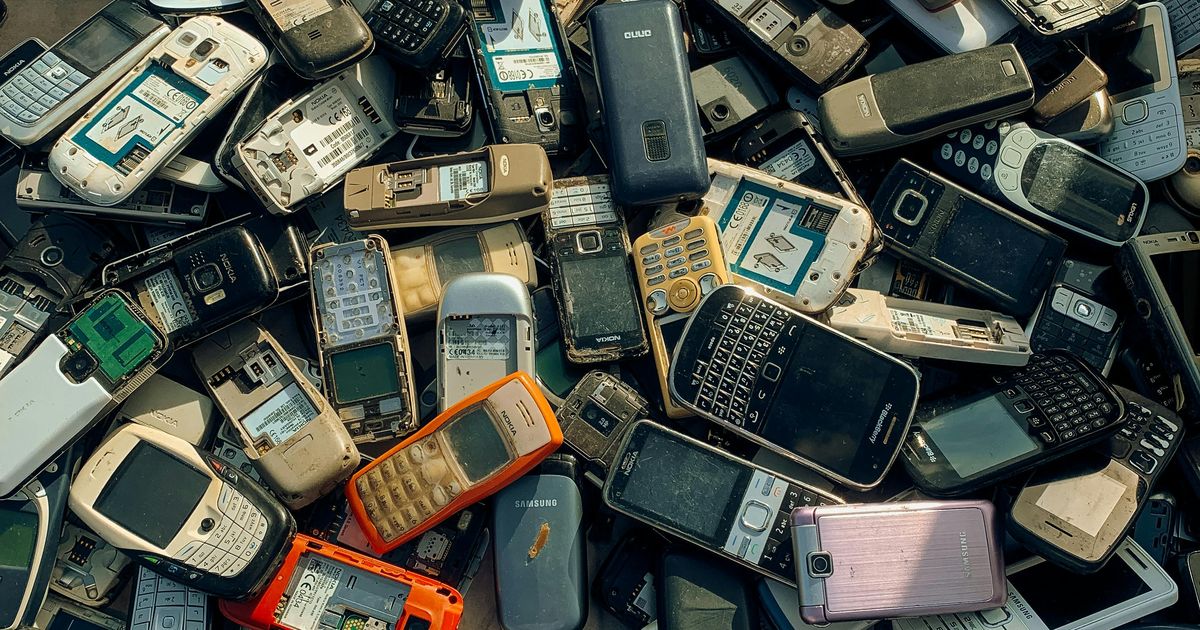
Most conversations about e-waste start and end with the environment. And the environmental case is real — but if that were enough to change behavior, we wouldn’t be generating record amounts of electronic waste every year.
The truth is, responsible IT disposal is a business decision. It affects your regulatory risk, your data security posture, your balance sheet, and your reputation. Here are the numbers that make the case — and what they actually mean for a business in Dallas-Fort Worth.
The Scale
The Global E-waste Monitor reports that worldwide e-waste generation surpassed 60 million metric tons annually and is projected to reach nearly 82 million metric tons by 2030. Only about 20% of global e-waste is formally documented as being collected and recycled.
That means roughly 80% of the world’s electronic waste is unaccounted for. It’s in landfills, in informal processing operations, in warehouses, or simply unknown. Some of it is sitting in your storage closet right now.
It’s worth pausing on that “unaccounted for” figure, because it’s the part that matters for businesses. Unaccounted-for e-waste isn’t just an environmental statistic — it’s a chain-of-custody statistic. Every one of those untracked devices left someone’s control without documentation of where it went or what happened to the data on it. When a regulator, an auditor, or a breach investigator asks “where did that equipment go?”, the honest answer for most organizations is “we don’t know.” That’s the gap responsible disposition closes.
The local picture makes the scale concrete. Dallas-Fort Worth has spent the past several years absorbing corporate headquarters relocations and one of the fastest data center build-outs in the country. Every relocation, refresh, and expansion pushes another wave of servers, laptops, and networking gear out of production. We covered the regional dynamics in detail in our state of IT disposal in Dallas-Fort Worth report — the short version is that DFW generates more retired enterprise equipment per year than almost any metro in the country, and most mid-market businesses here still don’t have a standing process for it.
The Regulatory Landscape
In the United States, e-waste regulations vary by state, but the trend is toward more accountability, not less. Several states have enacted extended producer responsibility (EPR) laws, some states ban electronics from landfills outright, and businesses that handle large volumes of IT equipment are increasingly expected to demonstrate proper disposal practices.
Beyond state law, federal regulations reach further than most people realize:
HIPAA applies to more than hospitals. Any covered entity or business associate — clinics, dental practices, billing companies, insurance brokers — is responsible for protected health information through the entire device lifecycle, including disposal. If you serve the healthcare sector, our healthcare IT disposal page covers what that means in practice.
GLBA and FACTA put similar obligations on financial services firms and anyone handling consumer credit information. The FACTA Disposal Rule specifically requires reasonable measures to protect consumer information during disposal — which is exactly the moment most organizations lose track of their equipment. Financial firms in DFW face this on every refresh cycle.
Government and defense contracting requirements add another layer for businesses in those supply chains.
The EPA’s Sustainable Materials Management Electronics Challenge provides guidance on best practices for electronics management.
Non-compliance isn’t theoretical. Fines for HIPAA violations alone can run from $100 to $50,000 per violation — and if improper IT disposal leads to a data breach, every affected record can constitute a separate violation. The common thread across all of these frameworks isn’t a specific certification or a specific destruction method. It’s documentation: proof of what you had, proof of how the data was handled, and proof of where the equipment went. To be clear about where we stand — we are not third-party R2 or e-Stewards certified. We compete on documentation and transparency, and that documentation is what your compliance framework actually asks for.
The Data Breach Risk
In 2023, the average cost of a data breach in the United States exceeded $9 million according to IBM’s Cost of a Data Breach report. While most breach conversations focus on network intrusions and phishing, physical media is an underappreciated attack vector.
Hard drives, SSDs, backup tapes, and flash media that leave your organization without proper sanitization are a data breach waiting to happen. Drives pulled from improperly recycled equipment have been found for sale on secondary markets — with recoverable data still on them.
This isn’t a hypothetical risk. It’s a documented, recurring problem that responsible disposition practices directly address. And it’s a risk that compounds while equipment sits in storage: a closet full of unwiped drives is an unresolved liability every single day it exists, whether or not anyone ever touches it.
The fix is well-established. Storage media should be sanitized using a process aligned with NIST SP 800-88 Rev. 2 guidance before equipment leaves your control, with documentation available for your records. For drives that cannot complete an appropriate sanitization routine, or when written policy mandates destruction, GreenIT can bring a portable crusher to approved DFW sites for witnessed on-site drive crushing. Tell us the media, witnessing, custody, and documentation requirements before scheduling so we can confirm the supported workflow. Our data sanitization vs. physical destruction analysis explains the decision.
The Value Recovery Angle
Here’s where the business case gets interesting: proper IT asset disposition often pays for itself through value recovery. Enterprise servers, networking equipment, and storage arrays depreciate — but they don’t become worthless overnight.
A server that hits end-of-warranty and gets replaced in a corporate data center might still have three to five years of useful life for a smaller organization. Processors, memory, and drives all carry individual resale value. Even end-of-life equipment has scrap value that offsets disposal costs.
The catch is that this value decays on a schedule. Enterprise hardware loses resale value continuously from the day it’s decommissioned — we broke down the curve in our post on server hardware depreciation for DFW businesses. Equipment that would have funded its own disposition at year three is scrap by year six. That’s also why “we’ll deal with it next quarter” is the most expensive disposal plan there is; the hidden cost of storing old IT equipment adds up in floor space, security exposure, and evaporating resale value.
This value recovery angle is also, candidly, our business model. GreenIT Pickup’s free pickup service is funded by refurbishment and materials recovery — functional equipment goes back into productive use, and the remainder is recycled for raw materials. That is why qualifying equipment mixes and quantities can support pickup at no cost.
The Reputation Factor
This one’s harder to quantify but no less real. Stakeholders, clients, and employees increasingly expect businesses to act responsibly when it comes to environmental practices. Having a documented, defensible IT disposal process demonstrates operational maturity and corporate responsibility.
Conversely, a news story about your company’s hard drives showing up in an overseas e-waste dump is the kind of reputational damage that’s hard to recover from. The Basel Action Network has used GPS trackers to document exactly this: equipment handed to “recyclers” that ends up in informal processing operations overseas. Your disposal vendor’s downstream practices are your reputation risk.
What This Means for Your Business
Responsible IT disposal isn’t a cost center. It’s a risk reduction strategy, a potential revenue stream, and a demonstration of operational competence. Organizations like the Solving the E-waste Problem (StEP) Initiative are working on policy frameworks and industry standards to help businesses navigate this landscape.
At the individual company level, the action items are simple:
- Have a plan. Know what happens to your equipment when you retire it, before the refresh — not after the old gear has been sitting for a year.
- Demand documentation. Asset lists with serial numbers, GreenIT-issued certificates of data sanitization, and a clear answer on where material ends up.
- Don’t let it sit. Every quarter in storage costs you resale value and extends your data liability.
- Treat retired IT assets like what they are — assets.
If you’re a business in Dallas, Fort Worth, Plano, or anywhere else in the metroplex, we make it easy to get started. GreenIT Pickup is headquartered in Southlake and provides free B2B equipment pickup across DFW, with data sanitization aligned with NIST SP 800-88 Rev. 2 guidance included. Questions about minimum quantities or what we take? Our FAQ covers the details.
Need IT Equipment Picked Up?
GreenIT Pickup provides free onsite pickup for qualifying B2B IT equipment loads across the Dallas-Fort Worth metroplex, so your team does not have to transport equipment to a drop-off.
Related Services
Related Articles
Refurbishment vs. Recycling: IT Reuse
Recycling isn't always the best option for old IT equipment. Learn why refurbishment and reuse are the top of the waste hierarchy and how they give hardware a valuable second life.
SustainabilityEnvironmental Cost of Data Center Upgrades
Data center upgrades generate massive amounts of e-waste. Learn the environmental impact of hardware refresh cycles and how responsible reuse and recycling can help.
SustainabilityNorth Texas Giving Day: Nonprofit Tech Cleanout
Before North Texas Giving Day 2026, DFW nonprofits can inventory, reuse and responsibly clear retired computers, servers and network equipment without a drop-off.